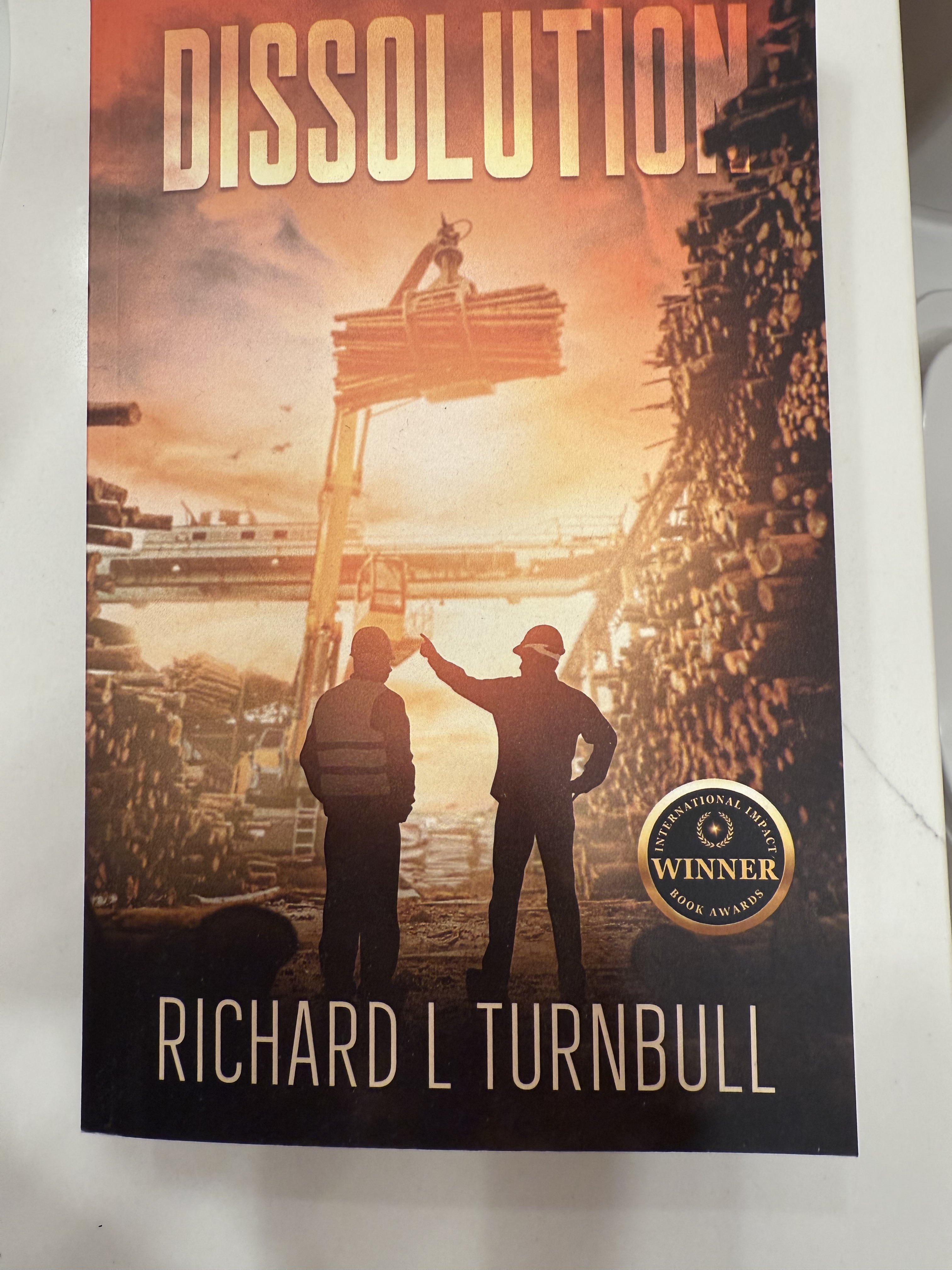
By Richard L Turnbull
FORWARD:
Our world is changing fast. Ideas we have taken for granted, ideas and institutions we may have been absolutely certain about, seem to be in freefall. Old norms of civil society have been trashed. People are seeking new ways of interacting with the rapidly changing environment.
Neither capitalism nor socialism seem to provide a path forward as economic drivers. But if you dare to question capitalism, even as the effects of capitalism are massive income inequality, and catastrophic climate change, it is likely to induce angry responses and accusations that you are a socialist or communist or anti-freedom. “If you don’t like it here, move to Russia, or Cuba, or Venezuela”, are likely responses. This binary thinking precludes the idea that there are other options that may empower economic growth and shared prosperity. Those two notions are not mutually exclusive.
The earth is facing ecological collapse due to our changing climate. And new ways of thinking about being in this rapidly changing environment are crucial to our continued existence as a species. Neither socialism nor capitalism offers solutions. Like capitalism, socialism relies on endless, exponential growth. To sustain this growth, our current model of extraction and consumption requires increasing environmental damage. While capitalism and socialism offer different choices of how to distribute the fruits of extraction, neither economic system is capable of solving the environmental catastrophe we face. The following story offers non-binary ways of thinking about the economies of the world.
Quote from “The End of Democratic Delusions in the January 2025 issue of the Atlantic by George Packer
“Civilizations rise. Civilizations fall. Some die slowly from inherited sloth. Some die quickly from pent-up rage. And some putrefy from corruption. As civilizations decline, new orders begin.”
Chapter 1: Skaiyu Falls – 2014
Sheets of rain blew crosswise across the Skaiyu River bridge. The windshield wipers were on full speed, and even with the headlights on, I had trouble seeing the road through the darkening gloom. I was almost home. I imagined the smell of the smoke from our wood-burning stove and the aroma of the roast chicken dinner my wife, Nancy, would be pulling from the oven. I was ready to be out of this storm and into our warm, snug cabin at the base of Bald Mountain. The rain ricocheted off the car’s roof like machine-gun fire. Then came a roar so deep and violent it seemed to come from inside the mountain itself. The thunderous roar was deafening. It seemed like the whole mountain was collapsing. Terrified, I spun the car around in the middle of the bridge and sped away from the mountain of mud, rocks, trees, and debris that were hurtling toward me. My wife and three children were at home – directly in its path. The mass of mud and boulders dammed the river, forcing it out of its banks. The river, swollen from a week of steady, heavy rain, was already at flood stage, and now it poured over the landscape cutting out my escape route. I turned west onto a gravel road, hoping I could reach higher ground out of the river’s path and the mud. When I was safe, I slowed down and tried to call for help. No signal.
My family had just moved to the small community of Skaiyu Falls. I had a paper map in the car to help us become familiar with the lay of the land. I frantically searched the map, looking for a route to the nearby town of White Rock. I was on USFS Road 63, which eventually merged with USFS Road 47, which led to the main highway to White Rock. I estimated it would take about half an hour if the roads weren’t blocked with downed trees. When I reached White Rock, emergency personnel were already mobilizing. There were dozens of emergency vehicles, all with lights flashing through the dark, sparking shadows of men in reflective vests.
At the White Rock Police Station, I told the duty officer what I had witnessed. Given the scale of the mudslide, it was possible that hundreds of people were buried alive under tons of mud and debris. An immediate response with heavy equipment was critical. The duty officer asked about the route I had taken. I assured him it was safe up to the Skaiyu River Bridge, but that the bridge was most likely demolished in the landslide, and the emergency crews would have to approach Skaiyu Falls from higher ground. The duty officer communicated that to the Incident Commander, who huddled with local and county officials to plan the immediate response.
I clung to a single, irrational hope – that my house had been torn from its foundation and carried atop the mudflow rather than buried beneath it. I needed to find a way back to Skaiyu Falls.
The entire community of White Rock turned out to help in any way they could. I joined a crew with bulldozers and dump trucks, and we set off through the dark. We used logging roads to head up the mountain to the northwest corner of what used to be the community of Skaiyu Falls. The person in charge was afraid the mountain was still unstable and that we would be in the path if it gave way. Despite the risk, we unloaded the D-9 dozers with their huge buckets and followed them on foot as they slowly and cautiously moved to the edge of the main scarp. About twenty of us were on foot, equipped with headlamps and shovels. The only light was from the headlights of the trucks, rescue vehicles, and our headlamps. I desperately searched through the dark, punctuated by the flash of search lights from the circling helicopters, for any sign of my house. I wondered how the helicopters could stay aloft with the high winds and driving rain. Could my family have survived? I hollered desperately into the dark, “Nancy!
My voice vanished into the rain.
“Sara!”
“Robbie!”
“Sophie!”, my voice dying in the heavy dank air.
“Wait,” someone said sharply.
“Everyone – stop.”
Engines died. The rain took over.
“Yeah,” another voice said.
“That’s a kid.”
“Where are you little one? It’s ok. You’re going to be ok. You’re not alone. Shine your lights over here, I can’t see him. Look! There! Throw me a rope! I’m sinking.”
“Tie it around your waist!”
“Easy-easy-don’t move, kid. I’ve got you.”
“Truck’s backing up!”
“Hold on-hold on.”
The truck backed up slowly, pulling the toddler and me out of the freezing muck.
We worked all night, but the only person we found was the toddler. There was no sign of my home. No reply from my incessant calls to my wife and children. Only darkness and rain.
The logging roads were turning to mud, and rear-wheel drive trucks slid dangerously on the steep hillside. Logging companies, like Beekman Enterprises, knew how to build roads quickly. They didn’t wait for permits. Beekman provided dump trucks loaded with gravel, dozers, and other equipment to build new access roads and repair the surface of existing roads so that rescuers could reach the slide area.
White Rock converted the school gymnasium into a shelter, providing rescue workers with clean clothes, cots, blankets, and a place to shower and clean up. Exhausted, hollowed out by despair and rage, I collapsed onto a cot. My entire family was dead – buried under tons of mud. How could this have happened? Was it just a fluke of nature that the mountain gave way? Could it have been prevented? Should I have known that the land was unstable? Should I have asked more questions before signing the sales documents? Jesus! Was I to blame for the deaths of my wife and children? I slept fitfully, dreaming I was caught in an avalanche and swept into a crevasse.
I awoke to the rustling of rescue workers preparing to resume search and recovery operations. After dressing in my donated clothes, I headed out of the school to get desperately needed coffee. I felt numb. My whole world had collapsed.
Fifteen people were rescued through airlift and on-the-ground efforts. But some of the rescuers who went in got caught up to their armpits and had to be dragged out by ropes themselves. It was just physically impossible to support human weight in the slurry that buried the community.
White Rock was teeming with news vehicles. A woman, worried about her uncle, raised her hand. Her voice shook. “Are crews still hearing people calling out?”
The County Commissioner paused. “No,” he said. “We are not hearing voices this morning.”
“The soil is unstable,” he continued. “We made the call early today. It’s not safe to put more people in that area.”
I walked across the highway to the White Rock Cafe.
“Coffee?” the waitress asked.
I nodded.
“I’m Mavie,” she said. “You helping with the search?”
I shook my head. The sob came before I could stop it.
“Oh,” she said softly. “Did you lose someone?”
She pulled a chair over and sat beside me. I began to cry; a deep uncontrollable sob that shook my whole body. I couldn’t answer. I buried my head in my arms on the table.
I couldn’t answer. The tears streamed down my face, and I convulsed with a tremor that rattled the salt and pepper shakers on the table. She sat with me, put her arms around me, and held me as I cried. Gently, Mavie released me, and softly said, “I am so sorry. This is not the end, you know. Not for you. Not for this town. We need to know what happened and why. Let’s get some food in you. How ‘bout some biscuits and gravy? We’ve got the best biscuits in the county. Hands down.”
I wiped away the tears with a thin, paper napkin and replied, “Thanks. You are very kind.” I took a sip of coffee and shivered. My brain was filled with questions. What must I do next? I needed to call my supervisor at the Seattle Times where I worked as a reporter. Where would I stay? Should I try to find a place in White Rock and report on the landslide? Could I be an objective observer?
Mavie appeared with a platter of biscuits and steaming gravy with a side of two eggs sunny-side up. I was hungry, and this country breakfast was just what I needed.
“Thank you, Mavie. This looks and smells delicious. I have a question for you. With my house buried under ten feet of mud, do you have any recommendations on where I could stay for a few days, maybe weeks?”
Mavie replied, “Well, we have a room over our garage you could use. I’ll have to check with my husband, but I’m sure he won’t mind. Mind you, it’s not much, but it’s dry, and we have a space heater you could use. Check back at lunch. Other than that, there is the motel down the street, but I heard it is full of rescue workers right now. You know, my daddy fought against that subdivision. He spoke out against it. The County Commissioners didn’t want to hear it. They claimed he was against growth and progress. Well, that may be partly true, but he works for the contractor that built those streets, and the gravelly soil on that steep hillside just wasn’t suitable for housing. At least, that’s what he said.”
She looked at me carefully.
“Turns out,” she said, “he may have been right.”
Did corporate greed – sanctioned, approved, and waved through – kill my family?
Chapter 2: What Caused The Slide? Searching For Answers
2014
For weeks, every thought of Nancy and my kids made me gasp and sob at the dark, hopeless finality of their deaths. The impossibility of their return to my life and the suffocating silence of the room above the garage left me devoid of hope. I could find no words for what I felt. I couldn’t sleep. I couldn’t eat. The terror of how they died overwhelmed me, compounded by the fear that my failure to research the property had led to their deaths. Had I failed to protect my family?
I couldn’t think. I couldn’t write. So, I walked. I walked through town. I hiked into the forest. I climbed to the top of the mountain and looked down over the debris field that buried my wife and my children. I sat at the top and shook with tremors of despair.
And then I walked.
I walked until I was exhausted and then crawled into the loft over the garage, where sleep came in fragments, nightmares punctuating the dark. Every day for weeks, I walked. Alone. Refusing – unable to engage with anyone. I walked toward nothing. I just walked. There was no destination. How could there even be a destination worth reaching? Every painful, heavy step a burden. And yet, I walked. Through rain, through cold. I plodded forward until I could walk no more. And would then return to my space over Mavie’s garage.
One morning, I heard a knock and opened the door to find Mavie standing on the landing holding a tray of pancakes, bacon, a pot of steaming hot coffee, and juice.
“It is time”, she said. “You need to eat.”
She handed me the tray, turned, and left.
The warmth of the food – and of the gesture – relaxed me. I felt my body soften, and I sat at the little table and devoured the kindness she delivered.
Somewhere beyond my walks, the investigations were beginning. I just wasn’t ready to face them yet.
Chapter 3: A Search For The Truth
Why did the mountain give way? I needed to know.
The Skaiyu River had been running high for days, thick and brown, pressing hard against its banks. At 6:12 p.m., the mountain let go. There was no warning siren. Some described the sound as a “freight train”, and others as “thunder that didn’t stop.” The upper slope sheared first. Not in one clean break, but in a long, horrible shudder. In less than a minute, forty homes were buried, and forty-three people were dead. The mountainside collapsed and slid over the community, moving 18 million tons of sand, glacier till, and clay; enough debris to cover 600 football fields 10 feet deep.
Later reports would describe the slide as a two-stage failure. The first movement loosened the slope. The second turned it into something else entirely. During the second stage, the landslide greatly accelerated, crossed the Skaiyu River, acquired additional water, and ultimately transformed into a water-saturated debris flow of a liquefied slurry of rock, water, and mud, entraining everything in its path. Houses were pushed off their foundations and carried downhill into the home below. There was no time to escape. What began as earth became motion.
The official report would later call it a “rapid mass-wasting event triggered by prolonged precipitation on a destabilized slope.” The phrasing was careful, neutral.
But what it meant was this:
The mountain had been weakened. The rain had pushed it past its limit. And when gravity took over, nothing human stood a chance.
My editors at the Seattle Times wanted answers as quickly as possible. So did I. There was nothing I could do in White Rock, so I drove into Everett to the Snohomish County Courthouse to review ownership records of the land that once was Skaiyu Falls. I wanted to know as much as possible about the history and ownership of the land used to develop Skaiyu Falls.
“Hello. I’m Robert Taylor with the Seattle Times. I’m investigating the Skaiyu Falls landslide. And, full disclosure, I am or was an owner of property in Skaiyu Falls.”
“Oh my, what a terrible situation. I’m glad you are okay. You must be one of the lucky ones.”
I stared at her. “I lost my whole family and my home, so I don’t feel so lucky right now.”
She blinked, unsure what to say, then straightened a stack of forms. “How may I help you?”
“I need whatever information your office might have regarding the development; surveys, building approvals, prior owners, soil tests, and anything that might help the public understand what happened there.”
The records clerk brought out a series of old geotechnical studies. The earliest dated back to the 1950s. None of the studies were conducted with an eye towards the risks of development. Prehistoric landslides of comparable size are present for several miles on both sides of the valley. These landslides could be reactivated or new ones initiated through river erosion or severe weather. The frequency of occurrence of these catastrophic landslides was unknown. However, groundwater conditions in the undisturbed sediments were known to contribute to slope instability and were not well understood.
Beekman Enterprises had responded immediately the night of the slide, providing heavy equipment and personnel. Lives may have been saved because of them. Lives may also have been lost.
I wondered how a developer could have received a permit to develop this slope for homes. What was the ownership history? I wanted to see a sequence of ownership. I learned that a company called Beekman Enterprises owned the property above the slide zone and had sold the land on the slope of Bald Mountain to a real estate developer in Seattle. I pulled the corporate registration documents for Beekman Enterprises from the Secretary of State database. The company had been operating in Washington for nearly seventy years.
The name that appeared on the original filings—and on most of the subsequent amendments—was Thomas.
I had heard the name before. Anyone covering business in the region had.
Beekman Enterprises was a privately held timber and forest management company controlled by the Thomas family, one of the largest landowners in the Pacific Northwest. Their operations stretched across Washington, Oregon, Idaho, and Montana.
The Thomases had a reputation as careful stewards of Northwest forests. Their charitable foundation funded scholarships at Yale and Oregon State University, as well as forestry research programs around the world. In business pages, they were often described as the last of the old timber dynasties.
One detail caught my attention. A Thomas family member – Jennifer Thomas – served on the advisory board that reviewed forest management practices for the state Department of Natural Resources. The same agency that had approved Beekman’s revised logging request.
I had never met any of the Thomases personally, but their name surfaced often in regional coverage – timber, real estate, political donations, philanthropy. The kind of family that quietly sat at the intersection of business and politics. The Thomas fortune had been built on timber, land, and the quiet mathematics of resource extraction – trees converted into board feet, and board feet into profit.
At the time, I had no reason to think the Thomas family had anything to do with the disaster at Skaiyu Falls.
But their name would appear again and again as my investigation continued.
In 2004, Beekman Enterprises applied to clearcut 25 acres of trees above the Skaiyu Falls community. The Department of Natural Resources denied their request. Beekman Enterprises resubmitted the application, reducing the harvest area to 15 acres. The revised plan was approved. The approved clear cut was not to intrude into a protected zone above the community of Skaiyu Falls. Photographers from the Everett Herald had taken aerial photos of the slide area, and they clearly showed that the clearcut area intruded into the no-logging zone right up to the edge of the slope. Interviews with the Department of Natural Resources (DNR) reported that a loss of trees heightened the risk of the landslide. The head of DNR stated, “Removing forest cover can increase the amount of rainwater that finds its way underground. Geologists say the extra groundwater can destabilize the already unstable soils deep beneath landslide zones.”
So, the question remained. Who was the developer, and how in the world could they have gotten permits to develop a community in an area known as a high-risk slide zone? The risks had been known for decades.
Ownership documents showed that Beekman Enterprises sold the land to Marshal-Feldman Development Corporation of Seattle, Washington. The Skaiyu River was well known for its steelhead runs and sea-run cutthroats. Marshal-Feldman, Inc. planned to develop riverfront vacation/fishing lots. The Skaiyu River had a sharp bend around the planned community so that the river bounded the community on three sides with Bald Mountain rising steeply above. The river cut into the mountain’s northwest flank. This made the area susceptible to slides which could impact the highway to Whitewater.
I obtained the address of Marshal-Feldman Development Corporation and the name of their CEO at the time the plat map was approved by Snohomish County Planning and Development Services. The CEO’s name was Sharon Anderson. I called the number for Marshal-Feldman, identified myself as a reporter for the Seattle-Times, and asked to speak to Ms. Anderson. The receptionist put me on hold. I listened to their canned music for a minute or two and then the receptionist came back on line and told me that Ms. Anderson was in a meeting and was unavailable. I asked her if she could schedule a meeting with me and Ms. Anderson. She replied that her calendar was full for the next two weeks. I replied, “That’s fine. I’m in no hurry. Just slot me in whenever she has a few minutes. I’ll wait while you check her calendar.”
“Look, Mr. Taylor, Ms. Anderson has no interest in speaking to the press right now. She is devasted about what happened in Skaiyu Falls and is going to take an extended leave of absence.”
I decided to try a different tack. “Please tell Ms. Anderson, that I lost my home and family in the slide. The meeting will be entirely ‘off the record’. I am hoping to get some understanding about what happened. I am not interested in legal remedies. I know she must also be going through a very difficult time. I’m trying to find closure and while she may not have any answers for me, she may have information that may help me deal with the pain I am feeling. This meeting may be good for both of us. Please have her call me.” I gave the receptionist my phone number, but didn’t expect to have my call returned. Never-the-less, I thought appealing to her humanity might get her to respond, especially if she had a conscience. The receptionist replied, “I’m sorry to hear about your loss, Mr. Taylor. I will give Ms. Anderson your contact info. Goodbye, Mr. Taylor.”
I was quite sure I would never hear from Ms. Anderson or anyone from Marshal-Feldman. My next thought was to try to contact the logging company that clear-cut Bald Mountain. Beekman Enterprises had responded quickly on the night of the slide, providing heavy equipment and personnel to support the rescue and recovery effort. So, on the one hand, they may have helped in saving lives, and on the other hand, their logging may have been a cause of the massive slide. I suspected they would be very worried about a class-action lawsuit by the surviving homeowners of Skaiyu Falls. I needed to be careful how I might approach them.
I called the local office of Beekman Enterprises located in Everett, Washington. They owned a large lumber mill and paper processing plant in Everett. I was born in Kamloops, British Columbia. My father, a country doctor, owned a thousand acres of forest land. When my parents died, I inherited the property, turned the house into an Airbnb, and vacationed there in the winter, skiing at Sun Peaks Resort, and fishing for lake trout in the spring and summer. Our land had never been commercially logged, and many of the Sitka spruce and Douglas firs were a two centuries old. By approaching Beekman as a possible forest harvester, I hoped to land a meeting with senior managers of Beekman Enterprises.
I called the phone number listed for the lumber company and asked to speak to the general manager. The receptionist asked what the call was regarding, and I told her that I owned some forest property in Canada and wanted to know if Beekman might be interested in harvesting the timber. She replied that all international sales and contracts were negotiated at headquarters in Philadelphia and provided me with the contact information I needed.
Needing to rebuild my life, selling some of the timber on my land in Canada would provide me with some much needed cash. So, the call to Beekman Enterprises had legitimate merit. I made the call. “Hello. This is Robert Taylor. I own some forest property in British Columbia and am interested in harvesting about 100 acres of the 1000-acre tract. I have contacted the local mill here in Everett, Washington, and they referred me to you. Do you have any interest in this harvest? And if so, could we arrange a time to meet?”
“Mr. Taylor, it is a pleasure to speak with you. My name is William Schnauble and I’m the VP for Wood and Fiber Procurement. We source eighty percent of our wood products from private landowners such as yourself. Other major wood products companies are heavily invested in land ownership, but we focus on harvesting and manufacturing, preferring to work directly with owners.”
“Any chance you could come for a site visit? I’d like to meet with you on site before your team does an appraisal.”
“That’s a bit unusual, but I will be in Vancouver for a wood products conference in May. I could delay my return flight and possibly meet with you on May 12th. Would that work for you?”
“I can make that work. I’ll send you directions to my cabin there. The drive up the Fraser River Canyon is spectacular. It’s about five hours. Or you can fly Air Canada into Kamloops, which is about a one-hour flight. But if you have time, take the road. I’ll have a maple old-fashioned waiting for you when you arrive.”
“Well, Robert, that sounds very hospitable of you. I look forward to meeting you. My secretary will be in touch with the details, and I’ll have an estimator contact you. See you in May.”
I had a little over a month to prepare for my meeting with Mr. Schnauble. I wanted to learn all I could about Beekman Enterprises. I learned they often used gyppo loggers, who were independent contractors. It was generally less costly for logging companies to use these independents rather than pay union scale for company employees. I learned a small local logging company, called Richards and Sons, logged the Bald Mountain site above Skaiyu Falls. Richards and Sons was owned by Daryl Richards. I called the phone number listed for Richards and Sons. “Hello. This is Daryl. Who is this and what do you want?”
“Hello, Mr. Richards. My name is Robert Taylor, and I am a reporter for the Seattle Times.”
“Fuck off, asshole. I ain’t talking to no press. Go mind your own fuckin’ business and don’t be botherin’ me no more. Ya hear?”
Well, that didn’t go so well. Maybe Mavie could help me deal with the locals. I decided to return to White Rock. I wanted a beer, and suddenly I was overwhelmingly exhausted.
When I arrived back in White Rock, I had dinner at the café. After dinner, I headed over to the loft at Mavie’s home. Mavie’s husband, Hal, seemed like a decent guy. He worked in construction framing houses. When he wasn’t working on houses, he was working on cars. The garage was nearly as big as the house. A block and tackle hung from the rafters. Currently, a big V-8 engine hung six feet above a light blue 1964 Mustang. Other cars in various states of disrepair littered the front yard. Tool benches framed all three walls of the garage, with a potbelly wood stove cranking out some serious heat. The benches and walls were covered with tools and jars of nuts and bolts and screws and washers. Coils of wire hung on little arms on the pegboard walls. Hubcaps were scattered in bins under the benches. The whole space smelled like grease and metal. Hal was lying under the car on a homemade creeper, and all I could see were his cowboy boots and blue jeans sticking out from under the car.
“Hey, Hal. When you get a moment, maybe you could help me. I’d like to interview some of the neighbors who helped in the rescue effort, and also to learn more about Bald Mountain and what may have caused the slide.”
“Yeah, give me a minute. I’m almost done down here. Even with my impact wrench, this rusted nut has been a bitch to get off. But it’s finally coming free. Grab me a rag off the front bench and that jar of Goop, would ya’? My hands are covered with grease.”
“Ok. Got it.”
Hal slid out from under the car, and I handed him the rag and Goop. He had a smear of black grease on his forehead, and his hands and wrists were covered with grease. He put a dab of Goop on his hands, rubbed them together, and then wiped his hands on the rag. About 80% of the grease came off on the rag, the rest he wiped on his jeans.
“I helped pull a toddler out of the muck. Do you know what happened to him?”
“Yeah, his parents were Jim and Marcia Vandervoort. They’re still missing and most likely buried out there. The kid is with his grandparents, who live in Sedro-Woolley. I guess he’s going to be all right.”
“Oh, thank God. Glad to hear he is ok. I went to the Snohomish County Courthouse today and learned that Daryl Richards was the guy who logged the top of Bald Mountain. I called him, but he wasn’t exactly interested in talking with me. I want to know if whether he received the 25 acre map that Beekman proposed to be cut, or the revised approved proposal of 15 acres with the protected setback area. Any chance you could help me with that? He basically told me to ‘fuck off’, and it was clear he wouldn’t talk with me.”
“Daryl Richards is the local resident asshole. He was in the Iraq war and came back pretty fucked up. He spends all his money on beer and has become a mean-ass drunk. It probably didn’t matter which proposal was given to him. He doesn’t pay much attention to the details. He’s gonna do what’s best for Daryl, and if it pushes through a boundary line somewhere, and it’s to his benefit, well, that’s just tough.”
“Well, in this case, people died. If he was given the wrong proposal, he has a chance to clear his name. If he were given the amended proposal, he would have serious liability. Could you talk with him to see if you can find out what happened?”
“Look, Robert, it ain’t none of my business, and I don’t want to go pickin’ a fight with Daryl.”
“Hal, a bunch of people died, and a bunch of others lost their homes. They’re also members of this community,and they deserve to know what happened. I’m not the police; I just want the truth about why this mountain gave way. My family is buried under there. I need to know.”
“Ok. I get it. I want to know also, and you’re right, the whole community wants to know what happened. I need to give Daryl some time. I’ll try to catch him at the tavern before he’s had too much to drink. Hal wiped the last of the grease from his hands and tossed the rag onto the workbench. “Give me a few days.”
I nodded.
The mountain had already given up some of its secrets. But I was beginning to understand that the story of Skaiyu Falls did not start with the rain.
Chapter 4: Sean Murphy
“Come here, you little shit. How many times have I told you to pick up your toys? That’s it. I’m going to smash all your fuckin’ toys! I said, come here, goddamn it.” And Sean’s father removed his belt and lashed Sean over and over. Sean knew not to cry, because then he only got beaten harder. His father picked up Sean’s toys, put them in a garbage bag, stomped on them, took them outside, and threw them in the garbage can before staggering back up the stairs and collapsing on the broken-down sofa.
His father, an abusive alcoholic, beat Sean whenever he deemed Sean to have misbehaved. Every Sunday, he went to church with his mother where she taught Sunday school at The Lord Has Risen Pentecostal Church. In church, Sean learned that God punished the wicked and rewarded the righteous. The world outside the church did not seem to work that way. Sean began to wonder if perhaps God simply needed stronger instruments.
In order to protect Sean from his father, she sent him to Vacation Bible School every summer. She was terrified of her husband, but felt that since God had brought them together, only God could separate them. So, despite the beatings she received, she prayed every day for her husband to become the man she fell in love with. And later, she prayed that God would take him.
Sean excelled in school. He would be beaten if he received less than an “A” in a class, so he studied hard. He was a naturally gifted athlete and in high school, earned varsity letters in football, basketball, and baseball. He played linebacker on the football team and earned recognition for his hits on opposing players.
The locker room smelled of sweat, wet grass, and liniment. Helmets clattered onto the floor. Someone blasted music from a tinny speaker, and the room filled with shouting and laughter.
“Jesus, Murphy,” a lineman said, slapping Sean on the shoulder pads. “You killed that kid out there.”
Sean nodded. His hands were still shaking, the adrenaline slow to fade. He peeled off his gloves and stared at his knuckles, scraped and swollen, the skin split in two places. Blood had dried in the creases.
“Hell of a hit, son,” the coach said as he passed by, already looking past him. “Textbook.”
Sean sat down at his locker and loosened his chin strap. Around him, teammates replayed the game in loud fragments—missed blocks, blown coverages, jokes about the other team’s quarterback. Two boys across the aisle bumped shoulders and laughed, their heads close together. Someone else shouted about a party that night.
No one spoke to Sean again.
He unbuckled his pads slowly. Beneath them, bruises bloomed dark along his ribs and shoulders, old ones layered under new.
They liked what he did. They liked the sound his body made when it collided with someone else.
Sean stood, towel over his shoulder, and headed for the showers. The noise behind him swelled, then faded. The hot water hissed to life, and steam rose to fill the room. Alone, he let his forehead rest against the tile and closed his eyes.
Sean hoped to play in the NFL one day, but he also dreamed of becoming an attorney to prosecute violent men like his father. Sean was tall and good-looking and was popular, yet he had no close friends. Sean felt a deep loneliness – not the loneliness of being alone, but the kind that comes from standing in a crowded room where no one truly sees you. The bruises on his arms could be hidden. The ones inside him could not. Yet no one noticed them either. Sean felt at times as if he was fading, disappearing into nothingness; that his life did not matter. He could be surrounded by friends, schoolmates, and family, and feel invisible. He went through the daily motions of existence with a soul-aching need that could never be filled. A loneliness of the absence of connection. He desperately sought to have someone understand his dreams, his complex needs and desires, yet no one could see him; could truly see him as he needed to be seen.
Like other teenagers, Sean attended parties thrown by his classmates while their parents were gone on vacation. While other kids were drinking or getting high, Sean remained sober. Occasionally, he would score with one of his classmates who had too much to drink, but the momentary high of sex was often followed by revulsion. He began to question himself; wondering if he should change to become what the world expected. Desperate to feel acceptance, he felt a need to be with a group. He feared being alone. He was afraid that his own essence was fading into oblivion. He drifted silently along, in noisy, crowded spaces hoping that one day, someone might understand.
Eager to get away from his father, Sean attended University of Pennsylvania on an academic scholarship and tried out for the Quakers football team as a walk-on. He did well in fall training camp and made the varsity as a true freshman. He played linebacker as he had in high school, but due to an injury to the starting safety, the coach moved Sean to the safety position because of his strength, size, intelligence, and quickness. Sean could equally crush the run and break up pass plays. His hits on opposing players were legendary. The echo of shoulder-pads crunching into running backs could be heard clear up to the announcing booth at the top of the stadium.
Academically, Sean did well. He joined the Penn Forensics Team and his opening arguments, rebuttals, and closing statements were skillful, terse, and often acerbic. Despite his thorough research and tightly structured arguments, judges occasionally docked Sean points for personal attacks. His response to his teammates upon receiving critical reviews by the judges was that he was only responding to weak, poorly articulated arguments. And his “attacks” were intended to challenge debaters to improve their logical reasoning and to better prepare for the anticipated rebuttals. He would never admit that he was in the wrong or that he should change tactics. Secretly, Sean believed most people were weak. They tolerated bad arguments, weak discipline, sloppy thinking. The world, he believed, needed stronger men.
One afternoon, on the way back to his fraternity, he started up the front stairs just as a young woman, obviously leaving a freshman exchange sponsored by the fraternity, turned, caught the heel of her shoe on the threshold, and lurched out of balance toward the stone stairway. Sean leapt up the stairs and caught her in his arms. She turned toward Sean who still had his arms around her, laughed and said, “Oh my God, thank you. You saved me.”
“These exchanges can be brutal”, he laughed. “But I’ve never seen anyone so anxious to leave that they actually try to dive down the stairs to get away.”
“Thank God you were there. Next time I’ll try a slightly more graceful exit.”
“My name is Sean. Sean Murphy.”
“I’m Jennifer. Jennifer Thomas.”
“It was a delight to catch you. I hope we meet again, but perhaps with a little less drama.”
Sean released Jennifer, and Jennifer stepped carefully down the stairs, turned and waved goodbye. There was a composure about her – something calm and self-assured – that Sean immediately noticed.
Chapter 5: Jennifer Thomas
The wind roared through the open door of the aircraft as the altimeter on Jennifer’s wrist crept past 12,000 feet. The Cessna shuddered in the thin, air, the metal floor vibrating beneath her boots. Below them, the Pennsylvania countryside spread out in green and gold squares of farmland stitched together by thin ribbons of road.
Jennifer leaned forward and looked out into the rushing sky.
The ground seemed impossibly far away.
Across from her, two other jumpers were checking their gear—tightening chest straps, tapping altimeters, giving each other quick nods. The jumpmaster crouched beside the door, one hand gripping the frame as the wind tore at his jumpsuit.
Jennifer checked her rig one more time.
Main canopy secure.
Reserve secure.
Altimeter reading steady.
Her heart beat faster—not from fear, but anticipation. The moment before the jump was always the same: the world narrowing to a single decision.
Step forward.
Gravity would take care of the rest.
The jumpmaster raised two fingers.
Two minutes.
Jennifer moved closer to the door. Cold air rushed past her face, whipping loose strands of hair against her cheeks. The smell of aviation fuel mixed with the sharp scent of the high-altitude wind.
The earth below looked peaceful. Quiet.
Up here, there was only the sky and the sound of the engine straining against the air.
The jumpmaster held up one finger.
One minute.
Jennifer felt the familiar calm settle over her. The same calm she felt before a difficult negotiation or a downhill ski run at full speed.
Control the moment.
Control the outcome.
The jump light snapped from red to green.
“Go!”
Jennifer stepped out into empty air.
For a split second there was nothing—no ground, no horizon, only the sudden absence of the airplane.
Then the wind caught her.
The sky roared past as she accelerated, the altimeter spinning steadily downward. Her body settled into position—arms wide, legs slightly bent, perfectly balanced in the rushing column of air.
The farmland below rushed closer, slowly at first, then faster.
This was the part she loved.
Total freedom.
Total control.
At five thousand feet she checked her altitude again, then reached back and pulled the ripcord.
The parachute exploded open above her with a hard snap, the sudden deceleration lifting her gently into the harness.
Silence replaced the roar of the wind.
Jennifer looked out across the endless fields and forests stretching to the horizon.
From up here the world looked orderly. Manageable.
But she knew better.
Gravity was always waiting. Jennifer trusted gravity. What she did not trust were the forces that men unleashed on each other.
Jennifer guided the parachute toward the drop zone, touching down lightly in the grass beside the hangar.
As she gathered the canopy into her arms, she felt the familiar rush of exhilaration fading into calm.
Moments like that reminded her why she loved skydiving.
But tomorrow she would return to a different kind of risk – the world of corporate law and the vast empire of Beekman Enterprises.
Jennifer Thomas, daughter of Benjamin Thomas, Jr., and Karen Miller, and heir to the Beekman Enterprises fortune, graduated from the University of Pennsylvania Law School and went to work for the family business as a corporate attorney. During college at the University of Pennsylvania, Jennifer took up skydiving, joined a skydiving club and competed in regional and national competitions. She was an exceptional athlete who loved sports of all kinds, especially skiing which gave her a similar rush as skydiving. Beekman Enterprises was a worldwide behemoth, owned entirely by the Thomas family. Initially founded by Henry Beekman, a cabinet maker, the company grew rapidly during World War I and World War II, supplying lumber and forest products to the US Military for planes, military housing, caskets, and gun stocks. Jennifer grew up with all the advantages and privileges of extreme wealth. She was attractive in a tomboyish way. She was confident, intelligent, and fearless. She lit up a room with her bright smile, and her gray-blue eyes danced with playfulness at times, but could also be cold as steel during negotiations. Jennifer, like her father, believed power was a tool. The question that mattered was not who possessed it, but what they chose to do with it.
Jennifer loved the forests her family’s company harvested. She had grown up skiing through them, fishing their rivers, breathing the cold resin scent of pine. Sometimes she wondered whether Beekman protected those forests—or merely consumed them more slowly than everyone else. Jennifer was looking forward to escaping Phildelphia and the relentless pressure of corporate law.The Thomas family owned a log home on Flathead Lake in Montana that the family used for vacations and business retreats. There were six bedrooms in the main lodge, four cottages and a conference center that could accommodate up to 100 people for meetings and meals. Beekman Enterprises owned mills in Reed Point, Missoula, Great Falls, Bonners Ferry, Coeur d’Alene, Kalispell, St. Regis, Thompson Falls, and Seeley Lake. Jennifer and Bill Schnauble, VP for Wood and Fiber Procurement, intended to meet with the management teams of each of the mills and production plants to review market opportunities, and pending federal forestry legislation, as well as the long-term impact of new environmental restrictions.
Jennifer’s first stop was to be at the Western Headquarters Office in Missoula, Montana, then on to a wood products conference in Vancouver, B.C., and finally to a mill in Philomath, Oregon that was struggling due to federal restrictions on old-growth cutting before returning to her home in Philadelphia.
As Jennifer contemplated her trip west, she remembered the linebacker who had caught her when she tripped on the fraternity steps. Sean Murphy. Intense eyes. Quick reflexes. A seriousness that seemed out of place among the laughing students.
Chapter 6: Kamloops, B.C.
I was looking forward to my trip to the family cabin in Kamloops and my meeting with William Schnauble. It was a long drive from Skaiyu Falls; approximately five hours if I drove straight through. I arrived on May 5th, a week before I was to meet with Mr. Schnauble so that I could stock the cabin, and get settled in. It felt good to be back “home”. It was raining when I arrived and there was a large puddle right at the base of the stairs leading up to the front porch. I made a mental note to have some gravel delivered to fill up the muddy puddle that was currently serving as a moat blocking my way to the double-door entryway. I stopped just short of the massive puddle, popped open the back of my Subaru Outback, and removed a pair of boots which I put on. I grabbed my suitcase and a couple bags of groceries, took one step into the puddle and then onto the stairs. I set everything down under the covered deck while I dug around in my jeans for the key to the house.
The house was built by my great-grandfather from cedar trees felled and milled at the homesite. As I opened the door, I was assaulted by the stench of a dead and rotting mouse. I searched the house, found the dead rodent in a trap set by the property manager and released the stinky critter into the garbage can just off the driveway. Field mice were a common nuisance in the spring, and traps were set in the attic and under the stairs as well as under the sink in the kitchen. I reset the trap, opened the windows to let in fresh air, and set about putting groceries away.
A massive river-rock fireplace anchored the great room, and a long maple dining table stretched across the opposite end of the cabin. Moose antlers hung above the mantle, a grizzly bear rug covered the floor. and the lake glittered just beyond the deck. It was rough, comfortable, and entirely mine.
My little patch of heaven included about 1000 acres of pine, spruce, fir, cedar, and hemlock as well as several varieties of maple and ash. The cabin was built on the shore of a small lake, maybe 20 acres in size. Two streams fed the lake on the east end, and there was a small creek on the west end of the lake that flowed out of the lake. My dad and I had built a dock and a small boathouse where we kept a row boat, two canoes, other water toys, and fishing gear. There was a large, partially covered deck on the lakeside of the cabin and a fully covered porch with log railings that ran the entire width of the entry facing the driveway. There were five steps leading to the double-door entrance to the cabin from the circular drive.
Whenever I return to the cabin, I wonder why I just don’t stay here. This is where I relax. This is where I am most creative. I love the smell of the cedar paneling, the warmth of the wood plank floors, the dry heat from a roaring fire in the fireplace. God, I love it here. I put a jazz record on the turntable and poured myself a glass of cabernet. I sank into a leather recliner and the stress of the world melted away.
I had a few days to prepare for my meeting with Mr. Schnauble. I planned to take him on a walking tour through the forest and show him the land I wanted logged. And in the process, I wanted him to trust me. I planned to share with him the loss of my family, but I wanted to assure him I had no intention of suing Beekman Enterprises. I just needed to know what happened and why. The Bill Evans record finished and I flipped it over to play side B.
In this area of winter ice and snow, the onset of spring meant the repair of damaged roads. I called the local quarry and requested a delivery of ¾” minus rock to fill the hole by the front porch as well as to re-dress the driveway. The quarry manager told me it might be a few days due to the demand of stone for road repair, but promised it would be delivered by the end of the week. I hoped it would be delivered before Mr. Schnauble arrived, but if it didn’t it was no big deal.
May 12th arrived, the rock had not, but I looked forward to my meeting with the representative from Beekman Enterprises. Just as I was cleaning up from lunch, I heard a snap and a squeak. From under the staircase, a mouse had triggered the trap which had snapped onto its tail and hind legs. With its front legs, the poor thing was pulling itself and the trap across the floor, squeaking away as it went. I decided I needed to put the injured animal out of its misery. I was afraid if I picked the damn thing up it would turn and bite me so I grabbed a broom from the closet. My hastily conceived plan was to sweep it out the front door, put it in a bucket of water and drown it. That seemed to me to be the most humane way to handle this situation. I swept the trapped mouse across the floor to the front door, flung open the door and swept the mouse right into a woman who had just safely navigated across the muddy puddle and was stepping up onto the stairs leading to the porch. The mouse and trap struck her square in the chest. She screamed, lost her balance and fell backwards into the puddle. Her white pantsuit was covered in mud and dirty brown water. Mud was splattered across her face, and the mouse, still alive, dragged the still attached trap across her bosom as she continued to scream. It’s hard to know what to say in situations like this, so in my somewhat pathetic way, I yelled, “holy shit. I am so sorry. I wasn’t expecting you, and didn’t see you coming. I am so, so sorry. Jesus, fucking Christ! Here, let me help you up.”
The lovely lady in the white pantsuit, didn’t seem to want my assistance, as she screamed at me. “Get away from me. What the hell? Are you insane?”
As she sat up and then stood up, she glared at me with anger flashing from her steel gray eyes. The front of her pantsuit was splattered with muddy water, the back of her outfit was solid brown mud. The mouse, still inching its way across the driveway and still squeaking needed to be stopped. I strode passed the mud-covered lady and stomped on the mouse’s head, putting an end to its pathetic squeaking.
“Sweet Jesus! You are insane!”, the visitor yelled.
“Hello”, I said. “I’m Robert Taylor. Please come in. Let’s get you cleaned up. I hope you aren’t injured.”
“Are you f…ing nuts? I’m not going in there with you. You’re a crazy man! This whole trip was a terrible mistake. I’m leaving. Get someone else to log your f…ing land.” And she turned to go.
“Wait. Wait. Wait. You aren’t Bill Schnauble?!”
“You’re not only crazy, apparently you are gender confused.”
“No. Wait a minute. I was supposed to meet a Mr. Bill Schnauble. Who are you?”
“I’m Jennifer Thomas, Vice-President of legal affairs for Beekman Enterprises. I attended the conference in Vancouver with Bill. He got sick and asked me to meet you. I said yes. Worst decision of my life.”
“Seriously, please come in. I have some very comfy sweats you could wear while I wash your pantsuit.”
“You can’t wash this pantsuit! It must be dry-cleaned! And no, I’m not entering your humble little hut.”
“I think we might have gotten off to a rocky start…”
Jennifer interrupted, “You think? You are an imbecile.”
“Look, Ms. Thomas. That may all be true, but let me run your pantsuit into the cleaners in town while you clean up. I’ll get something for you to wear, and there is a shower in the bath in the hallway. I’ll ask them to do an express clean and if it isn’t perfect, I’ll buy you a new pantsuit, or you can just keep my very comfy and stylish sweats.” I smiled, hoping that my attempt at rectifying the situation would ease the tension.
“I’m not wearing your sweats; I have clothes in the car. Bring in my suitcase, please. I will take you up on your shower offer.”
I grabbed Ms. Thomas’ suitcase out of the trunk of the sedan and carried it into the house, careful not to let the roller wheels touch the ground.
“Thank you”, she said curtly. “I seriously doubt that your little laundromat can dry-clean my suit before I leave, but I’ll hand it out to you and perhaps, by some miracle, they aren’t as incompetent as you, and can manage to get it clean. And, yes, if they ruin it. I will bill you for it.”
I drove quickly into Kamloops and stopped at the laundry, explained my predicament and asked if it was possible to get her suit cleaned in time. The lady laughed at me, but assured me that she could have the suit cleaned and pressed in two hours. I left the suit in her capable hands and hoped she was right. She said her daughter would deliver the suit to me as soon as it was ready. I blew her a kiss. She laughed. And I drove back to the cabin hoping that a shower would calm Ms. Thomas down, and that I could find a way to talk about logging and Skaiyu Falls.
“Are you married?”, she asked when I returned. “Because I took the liberty of snooping around a bit while you were gone. Obviously, the great room was decorated by some backwoods pioneer, but the bathroom, kitchen and main bedroom appear to have been carefully decorated by a woman with some good taste.”
Well shit, here we go I thought. No way to not just jump into the Skaiyu Falls story. Either she helps me or she doesn’t. “Let’s go for a walk”, I say. “I want you to see the area to be logged. The great room was decorated by my grandfather, the kitchen, bathroom, bedroom and basically the rest of the house by my grandma originally, and then by my late wife.”
“So, you were married. What happened?”
“Let’s go for that walk and I’ll tell you the story.”
We stepped out of the cabin and headed down to the lake. The sun was warm, the water was calm and perfectly reflected the surrounding trees.
“As I told Bill, I own about 1000 acres of forestland and want to clear about 100 acres. I’ve marked the area with blue ribbons. You’ll just see a part of it today, but what you see is representative of the whole section. If this project interests you, then great; you can send your estimators over. If not, then we will have had a nice walk in the woods. But, there was one other thing I wanted to ask Bill about. And that is Skaiyu Falls. Are you familiar with the slide in that area?”
“Yes. It made national news. A terrible tragedy.”
“You asked about my wife. She and my three children are buried there. Under the mud and rubble of the slide. Their bodies have not yet been found. Beekman Enterprises owns the land above the slide area and contracted with a gyppo logger named Daryl Richards. He won’t talk to me, but I am seeking closure. I miss my wife and kids more than I can ever convey to you. I need to know what happened there. I’m not looking for a financial solution. I have no intention of suing anyone. I just want closure. As the legal representative of Beekman, I can fully understand why you would not want to provide me with any information, but I am going to ask anyway.” Tears were rolling down my cheeks. I was desperately trying to hold it together. “Ms. Thomas, I want to know if the clear-cut instructions received by Daryl Richards were for the original request of twenty-five acres or for the amended and approved request of fifteen acres. Is there a way you could find out what documents Mr. Richards received?”
Jennifer wqas silent for a moment. The corporate attorney in her knew exactly what this conversation meant – liability, discovery, litigation.
But another part of her saw something else; a man standing in the woods who had just had his whole world shattered.
“Mr. Taylor, I am sorry to hear about your wife and children. I apologize for my earlier rudeness. Yes, I can research what exactly was sent to Mr. Richards. Everything is sent Certified Mail, and duplicates of all Certified Mail are made and kept on file for five years. I expect there may be a class-action lawsuit filed against Beekman Enterprises, since we are the entity with the deepest pockets. The documents you are requesting will certainly be discovered during such a suit, but if a lawsuit is triggered because you obtained or released those documents improperly, Mr. Taylor, you could find yourself in serious legal trouble.”
I nodded. I had come to Kamloops looking for answers about a landslide. Instead, I had just met the woman who might hold them.
Chapter 7: Benjamin Thomas
Benjamin Thomas stood at the window overlooking the Philadelphia skyline, a tall man with iron-gray hair and the quiet confidence of someone accustomed to being obeyed.
“Hello, Jennifer, how was your trip? Let’s schedule some time on Friday. I want a full written report on how the mills you visited are doing. How was the conference in Vancouver?”
“Well, dad, I’ve got a lot to report, so let’s block out two hours on Friday. For a quick snapshot, the mills in Montana and Idaho are doing well. The mill in Philomath may either need to be repurposed or shuttered. We can talk about that some more on Friday. The conference in Vancouver was interesting, there are new adhesives being developed at Oregon State University and new structural panels being designed that will benefit Beekman. And there is one other thing I need to talk with you about and I don’t think it should wait until Friday. Can we meet in your office now or later today?”
“I’ve got some time right now. What’s the urgency?”
“You’ll understand in a minute. Let’s step into your office. We need total privacy.”
Jennifer and Benjamin walked down the hall to Benjamin’s office. Benjamin asked his office assistant to hold all calls and they stepped into his office and closed the door.
Jennifer paused before speaking. Her father disliked surprises, especially legal ones.
“Dad, you remember that mudslide at Skaiyu Falls?”
“Yes, terrible tragedy. Something like forty people died, right?”
“Right, and get this. Bill was going to meet one of the survivors in Kamloops after the conference, but Bill got sick and I went instead. I thought, and I’m sure Bill thought, that this was a meeting to discuss a possible logging contract. But the owner of the Kamloops property is a guy named Robert Taylor, a reporter for the Seattle Times, and his entire family was killed in the mudslide.”
“Shit! What does this asshole want?”
“He wants to know if the gyppo logger we hired was sent a contract for the 15 acres that was approved by the Washington Department of Natural Resources. He claims the contract the logger received was for the 25 acres we originally applied for. If the logger received the original twenty-five-acre contract rather than the revised fifteeen-acre approval, the company could face significant liability in a civil action.” I promised I would check our records and let him know if and when such a contract was mailed.”
“Ok. Let me take it from here. I’ll have my assistant find the revised contract, and let you know when it was sent.”
“Sounds good. Have her send me a copy of the contract and a photo of the envelope with the date stamp.”
“No problem. That shouldn’t take her much time to find. I’ll ask her to get it to you by tomorrow afternoon. Ok?”
“Sure, dad. Thanks. I’ll work on getting my mill research notes in order for our meeting on Friday. See you, Friday.”
After Jennifer left, Benjamin placed a call to his security firm, Rangestone.
“This is Benjamin Thomas.”
Benjamin spoke calmly, as if arranging a routine shipment of lumber.
“I need you to come to the contracts office in Building B tonight after closing. I need you to find a contract. I’ll send you the details. If you can’t find the contract, I need you to create the contract, place it in an envelope, run it through the franking machine with a date of October 10, 2013, photograph it, and leave a copy of the contract and the photo of the envelope in a file folder labeled ‘Bald Mountain’. Take the envelope with the contract in it back to Rangestone and call me. If you find the contract, then photograph it and bring me the photo and a copy of the contract. Any questions?”
“No, sir. I’ll take care of it this evening, sir.”
Benjamin put the phone down and stared for a moment at the framed photographs on his desk – mills, forests, and boardrooms. Beekman Enterprises had taken a century to build. He would not allow one reporter and a landslide to bring it down.
Chapter 8: White Rock
I returned to White Rock, found Hal resetting the engine into the Mustang.
“Hey Hal, were you able to talk to Daryl about the clearcut instructions?”
“Yeah. I caught him at home before he headed to the tavern. I asked him what his contract said, and he showed me the contract he had received via certified mail from Beekman Enterprises. It clearly showed the 25 acres, not the 15. Once he got up there and started cutting, he realized it was a bad idea, but he said he signed the contract, mailed it back, and that he had no choice but to log the whole parcel. So, he did. And he knows that logging that parcel probably played a role in the damn slide. He thinks the whole town will blame him, so he’s not too shy about showing people his contract.”
“Thanks, Hal. This is important to me.”
“You plannin’ on suing Beekman?”
“No. That’s not gonna bring Nancy and the kids back. But I wonder what other sleazy things they may have done and I intend to do a little digging.”
Two weeks passed. I continued digging into Beekman’s records, but before I could learn much more, something happened that changed everything.
Around 2:30 a.m., I was called to the scene of a deadly accident. My host/landlord, Hal, was already there. The hood of Daryl’s Chevy pickup truck was folded like crumpled paper around a fir tree on a corner of the highway leading east out of White Rock. There were no skid marks, and in my interview with the police, Daryl must have been doing about 90 miles per hour when his truck left the road. Toxicology reports showed his blood alcohol level at .25, which could have caused a mental blackout. I spoke with the bartender and several other people who had been in the tavern that night, to get a sense of Daryl’s mental state. Was his behavior different from his normal behavior? Did he seem depressed or angry? The bartender seemed a bit cautious in his responses to me, but the customers I interviewed said that Daryl was in generally good spirits and that he apparently had made friends with an out-of-towner who stopped in for a drink. I asked if this person was still around, and no one seemed to have seen him after the bar closed. I asked Gene, one of the regulars, “Daryl’s blood alcohol level was off the charts, why was he drinking so much?”
“Well”, Gene said, “the out-of-towner was buying shots. Daryl was at his usual place at the bar. This guy walks in, takes the stool next to Daryl and they strike up a conversation. Next thing I know, the dude’s buying shots for everyone in the bar. Daryl drinks beer, so this guy orders a boilermaker for him. Well, Daryl had already had at least three beers, and every time Daryl finished one boilermaker, the guy ordered another one for him. At closing time, I offered to drive him home, and he told me to ‘fuck off’. I wasn’t going to push it, plus, I had probably had too much to drink also, so he stumbled out of the bar, got in his pickup and headed toward home. You might want to talk to Maggot. He might’ve seen something.”
“Maggot?”
“Yeah, Maggot lives in the shack across the street. A bit of a hermit. Rarely comes out of the house except to tend to his maggots that he sells to the general store for fishing bait. No one knows much about him. He’s been there for years. Everyone leaves him alone. There are rumors that he is batshit crazy, but I’ve never seen him harm no one. In fact, I’ve been here all my life and only seen the son-of-a-bitch half a dozen times. No one knows how old he is. He’s got long gray hair and a dirty gray beard. The dude’s got no teeth and his gums are always moving, like maybe he’s about to say something; but he never does.”
“Tell me more about the guy who was buying the drinks. What was this guy like? What did he look like? What kind of car did he drive?”
“Well, he was a big guy, looked like a logger, you know. Not fat, but muscular. He wore a ballcap, overalls, and boots. He drove a black Chevy Suburban. It looked new. I went outside for a smoke, and I remember thinking, no one in White Rock could afford a brand-new Suburban. At our little tavern, look around, nuthin’ but well used cars, mostly covered with dust and mud. But this guy’s rig looked like it just came from the dealer.”
“The police said Daryl was going about 90 miles per hour headed into that turn, did Daryl normally drive fast?”
“Shit no, man. The biggest danger to Daryl was getting rear-ended because he drives so damn slow. That boy was self-aware enough to know that he had to be extra careful. Sometimes the sheriff would follow him home to be sure he made it ok. No sense arresting him for drunk driving. It weren’t going to change his behavior none. We, here, in White Rock, look out for each other. But, Jesus Christ, man, we screwed up with Daryl. None of us should’ve let him drive.”
I headed back to Mavie and Hal’s place. Hal was working on an engine. Hal called me over. “You writin’ up an article on Daryl?”
“Yes. But I don’t have much; just the police report and some notes from people at the tavern.”
“Well, you might want to look at this engine. I bought the engine from the salvage yard. It came from Daryl’s pick-up. Look at this, here.”
“Hal, I don’t know much about engines. What am I looking at?”
“Well, this here is the throttle cable. See how it’s frayed? If a damaged throttle cable gets stuck in the open position, it could lead to uncontrolled acceleration.”
“Do you think Daryl had any idea the cable was in such bad condition?”
“Look, Robert, this cable has been tampered with.”
“How do you know?”
“See these marks on the cable? They aren’t like natural wear and tear. These were made by wire cutters, or a knife. The cable cover is intentionally roughed up. I know, ‘cause I helped Daryl rebuild this sucker just two months ago.”
I went back to the police station and shared what Hal had found.
Sheriff Rogers responded, “Robert, Daryl had a drinking problem. And yeah, he didn’t normally drive like that, but his blood alcohol level was off the charts, he could have blacked out. Who knows? The truck was a total wreck. The force of the truck hitting the tree caused all kinds of damage. The marks on the throttle cable could have been caused by the collision. Look, I liked Daryl. But damn, Robert, we all knew alcohol was going to kill that boy. This ain’t nobody’s fault but his own.”
“Okay. I’m not trying to start any conspiracy theories or anything. I’m just telling you what Hal showed me. I’m going to send you some pictures. Maybe you could just keep them in his file. Who knows, maybe someday we’ll find out more about what happened. Also, did you find anything else in the truck that was out of the ordinary?”
“No. Look, son, I know you mean well, but this case is closed. The only thing we found in the truck was a set of snow chains, his shotgun, and this here letter.”
“Can I see that please?”
“You can see what I see, and that’s the outside of the envelope. If you want to see more, you will need a court order.”
“Look, Sheriff. This is from Beekman Enterprises and it is sent “Certified”. Maybe Daryl did get the revised logging contract after all.”
“Give it a rest, Taylor, it doesn’t matter if that’s a revised contract. He obviously never read it, the envelope is sealed closed and so is this case. It is time for you to move on.”
I left the Sheriff’s office feeling frustrated. I wanted to know what was in that envelope. I didn’t think I had much of a chance of getting a court order. I resolved to wait until I heard from Jennifer Thomas. She promised to send me a revised contract if such a thing existed.
If Daryl Richards had something to say about Bald Mountain, he had taken it to the grave with him.
Chapter 9: Skaiyu Falls
2015
The more I thought about the envelope the sheriff found in Daryl’s truck, the more concerned I became. The envelope was clean, not all dusty and dirty like it should have been if it had been lying around in the pick-up for several weeks. I called my editor at the Times to see what he thought and to see if there was a legal way for us to examine the contents of the letter. The legal department at the Times told me that the letter would go to the executor of Daryl’s estate and it was up to the executor to decide whether to open the letter.
I learned that Daryl’s brother, John, was named the executor of Daryl’s estate. John had at one time worked with Daryl in the logging business but sold his interest to Daryl when he moved to Monroe, where he went to work as a prison guard in the Monroe Penitentiary. I contacted John, identified myself, and shared with him that I would like to do a story on Daryl’s life; his army experience in Iraq, the logging business, and whatever John would like to share about Daryl’s life growing up. A short tribute to Daryl in addition to the brief blurb I had written regarding the accident. I hoped to set up a time with John to meet at Daryl’s and go through some of Daryl’s things, including the letter from Beekman Enterprises.
The following weekend, I met John at Daryl’s house. It was a small 3-bedroom home built in the 1940’s by their father. It was a well-built home that had fallen into disarray. It hadn’t been painted in years, there were multiple junk cars in the front yard, the house itself was a cluttered mess of pizza boxes, beer cans and assorted junk. On the kitchen table was the letter that the sheriff had found in Daryl’s truck. John talked to me about their childhood; the tire swing on the cedar tree in the backyard, playing hide and seek in the summer until way after dark, hunting deer with their dad, and fishing in the Skaiyu River for steelhead. He talked about the logging business his father had started and how he and Daryl used to accompany him into the woods and help limb the trees that his dad fell. Eventually the conversation turned to the Iraq War and Daryl’s service in the Army.
“Daryl was gung-ho to go”, John said. “I’m two years younger and when I talked to my dad about signing up for the Army, he was adamantly opposed. By then, the war had been going on for two years, and the premise that there were weapons of mass destruction were proven to be false, and he was opposed to allowing me to go and fight a war that he believed to be wrong. And he told me he needed me at home to help with the business. So, I stayed. Daryl thought I was a chicken and he wrote me letters saying so. It never set well with Daryl, and when he got out of the Army, he came back to White Rock and took over the business. Dad had hurt his back and right leg when a hemlock he was cutting had a rotten core and snapped off the stump and knocked him backwards. He fell hard on a rock and ended up in the hospital with shattered vertebrae and a badly bruised leg. Daryl and I tried working together, and for a while it worked. But whatever happened in Iraq, changed him, man. He was not himself and would sometimes just fly into a rage for no known reason. Finally, I said, ‘fuck it’ and got a job at the prison. Daryl started drinkin’ and the business started to fall off, and I think he was depressed, you know? And I told him maybe he should talk to someone, and he went off like a rocket, accusing me of callin’ him crazy. Well, shit man, he kinda was crazy. But I couldn’t ever find a way to get him to see that he needed help. Guess I should have tried harder. Maybe he would still be alive. And then the Skaiyu slide happened, and I think he felt responsible since he had logged the crest. I tried to tell him that, if anyone, it was Beekman who was responsible, not him. It was their contract. They were responsible for the permit and all that shit. He was just doing his job. But man, he was in a deep funk.”
“Speaking of Beekman, let’s look at that envelope on the table”, I said. “Daryl’s original contract was for 25 acres, including the timber just above the slide area. The contract he showed Hal was for the whole 25 acres, but if Beekman sent him a revised contract for the 15 acres and he ignored it, then Beekman Enterprises may be off the hook, and your brother may have been at fault.”
John opened the envelope from Beekman Enterprises. Inside was a contract stamped “REVISED” across each page. I pulled out my phone and photographed the envelope and each page. The revised contract was for 15 acres. I looked at the date of the stamp on the envelope and it was mailed two weeks prior to the date Daryl began logging. Obviously, Daryl had never opened the envelope and was unaware that the contract had been modified. Never-the-less I found myself enraged that he failed to be responsible enough to even open the damn mail. Daryl, not Beekman Enterprises, was responsible for the deaths of my family and all the other people killed in the Skaiyu slide. I finally had my answer, and it was devastating. I rose from the table as every muscle in my body contracted at once. “Fuck”, I screamed. Your fucking brother killed my family.” And without thinking, I upended the table and it slammed into the kitchen cabinets. I grabbed the chair I had been sitting in and flung it across the room. John stood there, staring.
“Calm down”, he said.
“Fuck you”, I yelled. “Your goddamn brother murdered my family, and you want me to calm down? Well, fuck you too.” I stormed out of the house, got in my car, slammed the door and peeled out of the driveway, spewing gravel everywhere as I sped out to the county road. I drove to the site of the slide. It was cordoned off by temporary barbed-wire fencing, but I pulled over to the side of the highway, and stepped out of the car. Somewhere under that monstrous pile of mud was my family; killed by some ignorant logger. I hoped he was rotting in hell. I hoped he wasn’t so drunk when he died, that he could feel the crush of his body in the accident. I hoped he suffered. I hoped his death wasn’t immediate, that he had time to feel his broken bones. I hoped he was conscious enough to suffer remorse for the people, my people, whose deaths he caused. My tears flowed like the Skaiyu River. I doubled over with the emotional pain, and fell to my knees on the rough gravel shoulder, sobbing uncontrollably.
I drove slowly home, took a sleeping pill and fell into a restless sleep, dreaming of a Sunday picnic with my family. The sun was warm. The kids were down by the river skipping stones and laughing. Nancy and I were lying on a blanket. Life was soft and good. And then the roar. The roar of the river suddenly swelling to flood stage. Panicked, I ran to the river to grab my children as a ten-foot wave of water careened down the canyon and swept us up into the current. I grabbed onto a branch, but my children and Nancy were nowhere to be seen, but the roar continued. I awoke startled and sweaty. The roar of jets overhead brought me back to reality. A formation of the Blue Angels, practicing for Seafair, the summer celebration in Seattle, flew overhead.
I drove into the office. I had only been to the office a couple of times since the mudslide. I could do most of my work in the field, but I had a deadline to meet and there were records in the office from Washington’s Department of Natural Resources regarding the Skaiyu slide, that I needed as source documents for my article. On my desk was a stack of mail. One of the envelopes was from Beekman Enterprises. I opened it to find a letter from Jennifer Thomas, and a copy of the contract sent to Daryl. I quickly typed a thank you reply, and took it to the mailroom to be mailed. I gave the mail clerk my letter and the address to which it should be sent. It was then that I noticed the franking machine that inked the proper postage onto the envelope.
“Excuse me”, I said, “but does the date stamped by the machine automatically change at midnight to the next day or is it manually changed?”
“Oh, the date changes automatically. I don’t have to do a thing. But, if you wanted to post-date a letter, the software is flexible enough to make that change. The legal department sometimes does that when they want a letter to go out on a specific day.”
“Ok. Thank you.”
In the meantime, I decided to pay a visit to Maggot. I pulled up in front of his shack which was directly across from the tavern. The cabin was about twenty feet wide with three rickety wood stairs leading to a small wood porch. The house looked like it had never been painted. Cedar trees and brush hugged the house with limbs from the cedars overhanging the moss-covered roof. I couldn’t see the sides of the house because thick brush covered the entire width of the lot on both sides. There was no path around the house, just dense underbrush and cedars. The house was in continuous shade and looked abandoned on the side of the highway. I knocked on the door. There was no answer. I knocked again, this time a little louder. Again, no answer. I looked through the window into what appeared to be a kitchen. The lights were off and the whole place looked dark. I tried the door and it was unlocked. I opened it and called out, “Hello, is anyone home?” There was no answer, but I heard a shuffling and a screen-door slam shut.
“Who’s there and whaddya want?”, said a voice approaching from the back of the house. A figure of a man slowly emerged, shuffling barefoot down a narrow hallway toward me. Light, through the back door highlighted him. He was dressed in blue overalls and a plaid flannel shirt. His long gray hair hung to his shoulders.
“Sorry to bother you sir, I’m Robert Taylor. I used to live in Skaiyu Falls, but my family was killed and my house is buried under the muck.”
“You lookin’ for a handout or sumpin’?”, Maggot interrupted.
“No, but I hoped I could talk with you a minute about Daryl’s accident.”
“Tweren’t no fuckin’ accident. That drunk-ass boy was murdered.”
“Murdered?”
“You bet your ass, sonny boy. And who the hell are you anyway? I should learn to keep my mouth shut. I don’t need or want no trouble, you hear?”
“I’m Robert Taylor. I work for the Seattle Times and I want to understand how my family died.”
“Look, like I said, I don’t want no trouble and I ain’t saying nuthin’ more.”
“I promise I won’t mention this conversation in any story I might write. I’m just trying to come to grips with the death of my wife and kids. That’s it, Mr…shoot, I don’t know your name.”
“Folks here, call me ‘Maggot’. I know it sounds a bit derogatory, but I don’t mind. I keep to myself and wish others would do the same.”
“Well, Maggot, murder is a serious thing. Why didn’t you tell the Sheriff what you know?”
Maggot slid his lower jaw to the right and then to the left and then through his gums said, “There’s a reason I mind my own fuckin’ business. The Sheriff’s not gonna believe the word of some crazy ole coot who lives in a shack. The whole town thinks I’m nuts, and maybe I am.”
“Well, off the record, could you at least tell me what you saw? I won’t tell the Sheriff and I won’t use it in any story. Tell me this, if I was to write up a story, would I be in danger?”
“You write that story, you’ll be dead by the next morning. It’ll be a tragic accident. And the headline in the paper, will be, ‘Survivor of Skaiyu Falls Mudslide Dies In Tragic Accident’.”
“Ok, then. I’ll be extra careful. What did you see the night Daryl died?”
“I was in the front room, here. The lights were out and I was listenin’ to Coltrane on the record player over there. I saw a black SUV pull into the Tavern. Never seen a rig like that stop here in White Rock, so I got meself up and went to the window. The driver, this big dude, gets out and walks into the tavern and then this skinny dude, dressed in black, walks over to Daryl’s truck. I can’t see what he’s doin’ but I know he’s messin’ with sumptin.”
“You’re telling me there were two guys in that rig?”
“That’s right, sonny boy. There were two of ‘em. Now, you listen to me, and you listen good. You say anything about this, we’re both dead, you hear? I shoulda kept my mouth shut. Now, go on. Git outta here. I’m done talkin’.”
The conversation with Maggot haunted me for weeks. I spent the next few months interviewing survivors and neighbors who lost friends or family in the slide. I wrote a series of articles based on those interviews in order to keep the slide front and center in the local news, and to hopefully apply pressure on government officials to develop zoning laws to prevent future occurrences like the one that killed my wife and kids.
I wanted vengeance. I wanted those responsible for all of the deaths to pay a price. I organized a community meeting for the survivors with the purpose of filing a class action wrongful death lawsuit against the state of Washington and Beekman Enterprises. I wanted them to pay. I didn’t care so much about the money. I just wanted them to feel the pain and to recognize the pain their irresponsible actions had on the Skaiyu Falls families.
I went to the mudslide nearly every day. One thousand acres of gray-brown mud. No life. No birdsong. Nothing. Just an eerie silence. My family was still buried there. I wanted to keep the anger alive until some form of justice was served. I knew it was irrational, but I didn’t give a shit. With tears streaming down my cheeks, I screamed into the now desolate void. Somehow the anger kept me going. I shivered over wondering what their list minutes of life were like. Were they crushed to death? Or did they suffocate as the house filled with mud? I sunk to my knees and wept. My body convulsing on the cold hard pavement. I was powerless. I had trouble sleeping and often awoke with nightmares. I wondered if I had pushed too hard to move to Skaiyu Falls. Nancy had hesitated at first. I had been the one drawn to the river, the fishing, the quiet cabin in the woods. I believed the whold family would come to love it. But now they were gone. I understood the finality of death, intellectually. But I didn’t understand how it would feel. It feels dark and heavy. And it never leaves. It is a leaded shawl that ceaselessly weighs on me. It is a heavy void. A black hole that traps all light. A heavy emptiness.
I tried to find out as much as I could about Beekman Enterprises, but because it was a closely held private corporation and was not publicly traded, the Securities and Exchange Commission (SEC) showed little information other than annual statements of total assets. But those assets were considerable.
Chapter 10: World Business Federation
2015
The World Business Federation (WBF) met four times each year in secure locations that changed with every gathering. Few people outside its membershipknew it existed. Those who did rarely spoke about it. These few companies comprising finance, banking, technology, weapons manufacturing, food production, communications, energy, and natural resources own 20+% of total world wealth. Through the control of technology, they control the flow of information. They have sufficient resources to buy elections, control world monetary policy, finance wars, and allocate natural resources and energy supplies. They determine which energy sectors succeed. If manufacturing solar panels is to their advantage, they provide the financing necessary to fund the manufacturing of solar power. If rising oil prices serve their interests, the necessary conditions tend to appear. Through their think tanks, they draft farm policy, forestry legislation, and other laws and legal strategies that improve their wealth and increase their power. To obfuscate and distract people from their real agenda, they flood the news and social media with fake news and conspiracy theories. If the media can’t be trusted, then trust in institutions break down which in turn allow their surrogates to rise to power. WBF representatives are deeply imbedded in governments throughout the world to ensure their policy objectives are met. Those policy objectives are set at the quarterly meetings. Beekman Enterprises has been a member of the WBF since 1948.
It was time for Benjamin Thomas to introduce his daughter, Jennifer, to the WBF. On their flight to Buenos Aires aboard Beekman’s private jet, Benjamin turned to his daughter, “Jennifer, this is an important meeting for us. First, your introduction. There will be a meet and greet before dinner this evening, where I will introduce you formally to the group. You will represent our industry when I cannot attend. The WBF previously approved your membership. These are serious people and you must never betray them. Ever! Your life and the lives of those you love depend on your absolute loyalty. More than one person with a huge ego thought they were powerful enough to break from the WBF, and they are no longer with us. You will inherit Beekman Enterprises when I die. It is critical for you to be able to navigate your way in the WBF before I hand over the company reins. Your grandfather did the same for me, as his father did for him. The world depends on us even though the world is unaware of our existence or our power. What we do here, the actions we agree to, impact all of humanity. We are not a benevolent institution, and need governments to buy our products and services. We have members in key positions in all major countries to ensure our readiness to respond to political or military actions. We control that by ensuring we have friendly allies in seats of power.
One other thing, I will be presenting a novel approach to business today which could apply to all industries. Many will reject it out of hand. Some won’t listen, because they have fixed ideas about the past and will reject calls for change. Even if the change is for the better, they don’t want to see the truth; they want to maintain their traditions. But, in the long-term, I am convinced this will be the economic model of the future. It will make us more profitable, and will be necessary if the planet is to remain habitable.”
“Is it like what we are doing with fiberboard?”
“Yes, exactly. The waste from producing lumber and plywood is re-utilized in the production of medium-density fiberboard (MDF). The resin is used in fiberboard, rosin for bows for musical instruments, incense, concrete production, and many other uses. Any other residual waste is used in our bio-mass generators to power our mills. The principles of this circular approach to forestry is applicable to almost every industry. The World Business Federation has representatives on the Intergovernmental Panel on Climate Change (IPCC) so that we can control the pace of change, and can direct resources to the development of technologies to mediate climate warming and thereby profit from it. It is now clear that humanity is the primary driver of climate change and while we may profit from linear economics in the short term, current practices are unsustainable in the long term.”
“What do you mean by ‘linear economics’?”
“Well, Jennifer, the linear economy is the take it, make it, use it, dispose of it economy. Let’s take forestry for example. If we clearcut trees, make lumber, and then move on to the next section of timber and fail to replant, and just shove the mill waste into giant piles to rot, that is linear. But now we harvest and replant. We mill logs into lumber. We use the waste wood and sap to make fiberboard, and sell the remaining waste to other industries which have found other uses for what we once just threw away. We make money on the lumber, the fiberboard, and what used to be waste.
We have a brilliant young man named Leon Randall working in our Cyber-security sector who is also an accomplished designer. While working on our security network, he designed equipment improvements for our mills. That work was completely out of his assigned area, but something he did on his own. His family were mill workers at our facility in Missoula. At first, he was disciplined for working on company time on projects unassigned, but his designs have now saved us thousands of dollars and our head of engineering asked him to work on designing a submersible that is capable of mining poly-metallic nodules found on the sea floor. His design looks promising.
Beekman Enterprises has just purchased a Canadian mining company which has helped fund ocean mapping. The result has been the discovery of enormous amounts of cobalt and manganese nodules in the Pacific Ocean. These nodules are just lying on the ocean floor ready to be picked up. The submersible that Leon is designing may be used to “farm” the ocean floor for these potato-sized rocks that are rich in the metals needed for electronics and batteries. To make this process circular, we could power the submersibles with nuclear power, magnetically mine the nodules without disturbing the seabed, move the nodules to processing ships which would capture the cobalt and manganese and other useful metals, and send the remaining waste back to the mainland for sale for other purposes.”
The plane landed at a private airport. Jennifer and her father stepped into the back of a gray Maybach as soon as they set foot on the tarmac. The driver drove straight to a non-descript four-story concrete building in the Recoleta area. The white building was surrounded by a tall concrete wall with an iron gate. The driver opened the gate with the press of a button. As they approached the building a portion of the wall opened and they drove into an elevator which descended to an underground garage. They were met by armed guards who escorted them to their rooms on the third floor. Their spacious adjoining suites were opulent.
Before they adjourned to their separate suites, Benjamin said, “The meet and greet starts in an hour. Time to freshen up and change. Cocktails and dinner tonight. The meeting starts tomorrow morning at 8:00 with breakfast. Go light on the cocktails. See you in an hour.”
Jennifer made it through the meet and greet and retired early at 11:00 pm. She was careful to memorize names and faces of these extraordinarily wealthy and powerful people. As Beekman’s chief attorney, she had met a few of these people at merger negotiations, but like her father, very few members of the WBF were well known. Their anonymity was important to their power within the WBF.
Jennifer awoke early, spread out her yoga mat and completed her pre-dawn exercise routine. She showered, dressed and prepared for the morning’s meeting. Shortly before 8:00 am, her father announced it was time to leave for breakfast. They exited their suites, entered the elevator and Benjamin pressed the down arrow. There were no floor numbers in the elevator. Benjamin’s fingerprint guided the elevator to the proper level. They stepped out of the elevator into a ballroom with twelve round tables and found their assigned seats near the middle of the room. The morning’s agenda was printed on a card at each place setting. There were five items on the agenda including Benjamin who was scheduled to speak last.
Robel Valenzuela opened the meeting. “Good morning, friends. We have much to discuss today. The develpments in Crimea and Donbas are proceeding largely as anticipated. The situation will likely constrain Russian capacity for several years. Likewise, the presidency of Obama will trigger a racist backlash. A certain candidate in the United States is proving particularly receptive ot our support. His natural bravado and ineptitude will weaken the United States. The Eurozone is sliding into its third recession in five years. The time is near when each of the three major powers will lose their world influence. The era of the New World Order is about to begin. The Chinese situation is complex, but we will hear later from Mr. Chen about the devaluing of the yuan and its impact on Chinese growth. The wealth and power of the WBF is about to surge. Mr. Chen, please come to the dais.
“Thank you, Chair Valenzuela. You all remember the aviation incident over the South China Sea,” Mr. Chen said calmly.
“It carried the daughter of our own Mr. Tan who foolishly and carelessly let her fly on a public carrier. A tragic event. But it served as a useful reminder that some technologies are not meant to circulate outside our community. Mr. Tan learned that lesson too late. History has shown that those who attempt to disance themselves from this organization rarely find the outcome favorable.”
“Our technology remains safe. The death serves two purposes. It raises questions of the airspace over the South China Sea, and acts as a reminder to those who may wish to betray us. The South China Sea will become ever increasingly important to world commerce and a warning to China is important. Our representation within the Chinese political system remains insufficient. China’s economy is growing too fast and its increasing power is not to our advantage.”
Jennifer felt a sudden chill. The room was full of polite conversation, but beneath it ran something colder – a quiet understanding that membership here was permanent.
“Thank you, Mr. Chen.”
Chen finished speaking and sat down. No one at the table asked for clarification.
“Ms. Coates, please bring us up to date with affairs in the UK.”
“Thank you, Mr. Chairman. The Scots will vote on September 18 to either breakaway or stay. Despite recent passions, our sources believe the Scots will remain in the kingdom. Their presence is important for now. Britain needs to appear strong and independent from greater Europe. The time will come when we need to pull out of the EU, but right now our presence is important in shaping policy on the continent. A weakened Europe can come later.”
“Thank you, Ms. Coates. Mr. Van Deusen, Please come to the dais.”
“Thank you, Mr. Chairman. The EU is faltering. Italy is already in recession. France and Germany are teetering on the brink. Even if Europe as a whole manages to stay out of recession, sluggish growth isn’t enough to bring down high unemployment rates. The European Central Bank may propose stimulus plans, but the details aren’t settled yet. If youth unemployment continues high, the nationalist and populist parties will gain strength.”
“Thank you, Mr. Van Deusen. I will point out that some members believe the instability in Eastern Eruope presents opportunity. Others believe it introudces unnecessary volatility. Now, Mr. Mahmoud, please update us on the Middle East.”
“Thank you, Mr. Chairman. The rise of ISIS in Iraq following the American retreat has become an uncontrollable force. It is rising as a backlash to the brutality of America’s so-called “shock and awe” killing of tens of thousands of civilians in urban neighborhoods. Despite its equal cruelty, it has lots of support in this region due to American excesses. The rise of their power will result in instability in the whole region for years to come. There is a great opportunity here for us to exploit and benefit from the resulting chaos.”
“Thank you, Mr. Mahmoud.”
Jennifer realized that no one in the room had openly claimed responsibility for anything. Yet every sentence carried the quiet certaint of people accustomed to shaping events.
“Mr. Thomas, you have requested time to share your economic views. Please come to the dais.”
“Thank you, Mr. Chairman. Many of you are aware of the principle of circularity, but you may not be aware of how potent a circular economy can be for your bottom line. As you know, Beekman Enterprises profit has soared over the last five years. We are now the largest privately held company in the world and what I have to report, I believe can be translated into financial success for every sector of the economy. If you have followed our growth, we grew by slowly acquiring more land, building more mills and selling more lumber. We then grew by acquiring other like companies, and innovating new products. But as the housing boom slowed, we began to focus on productivity and waste reduction. We were still practicing a linear economic philosophy, but recently we have discovered a way to massively increase our wealth by the total elimination of waste.
Let’s take General Motors for example. In 2011 it launched a zero-waste program and now recycles 90 percent of its worldwide manufacturing waste, and generates over $1 billion from by-product recycling and reuse. There are many other success stories such as Proctor and Gamble, Electrolux, 3M, and others. The importance for this group is that it would be helpful for us all if tax policies would change from taxing labor, to taxing waste. This would make the transition to zero waste quicker and more effective. The workers will gleefully accept this change in taxation, and we, in turn would benefit mightily. Having the lower and middle class on our side will ease and speed the transition to the New World Order. The time is drawing closer, my friends. As George Bush once said, ‘The world we’ve known has been a world divided – a world of barbed wire and concrete block, conflict, and the cold war. Now we can see a new world coming into view. A world to which there is the genuine prospect of new world order. A world where the United Nations, freed from cold war stalemate, is poised to fulfill the historic vision of its founders. A world in which freedom and respect for human rights find a home among all nations.’ The era of nation-states is nearing an end. If you are interested in more information on the circular economy, I will be hosting a workshop tomorrow morning at 10:00 am in the adjacent conference room.”
“Thank you, Mr. Thomas. I’m sure many of our members will be interested in attending your workshop tomorrow. That concludes this morning’s session. We will break for lunch and resume at 2:00 pm. Meeting is adjourned until then.”
Following the workshop, Jennifer and Benjamin had lunch together before packing up and returning to Philadelphia.
“Dad, it’s only a couple of months until Sean and I are married. I know you and mom have invested a fortune in our wedding and reception at the City Club of Washington, and Sean and I are very grateful for your support. We will be moving soon to Montana and I know you had said you wanted me to continue to be involved with the business. Is that still your expectation and is it realistic that my separation from the heart of the business is beneficial to the business?”
“Look, Jennifer, as VP of Legal Affairs your work can occur any place in the world. I’ve had Rangestone set-up your office with the latest security, so your communications with me and with others is safe and secure. You have a trusted lieutenant in Marc Shaftsbury, who can manage any local legal issues that may need to be addressed, and you’re only a plane ride away in case you need to testify to Congress or other governmental entity. And one other thing, Jennifer, you need to keep some reins on that soon-to-be husband of yours. Sean is smart, gifted, and while his ideas of federation are in alignment with ours, he is a bit of an extremist. You may be the perfect check on his more reactionary impulses.”
Chapter 11: James Earl Swanson
2010
James Earl Swanson worked as an investment broker for GEM Investment Group in Miami, Florida. GEM specialized in money transfers to offshore tax havens for wealthy investors. They charged a healthy fee for discretion,and the investors’ money transfers were shielded from income taxes, saving them millions. One of James’ accounts was Beekman Enterprises who legitimately owned property in the Cayman Islands. James’ work life consumed him. He lived an extravagant lifestyle and loved to gamble. He named his yacht “Liquid Asset” and hosted extravagant party cruises. Eventually his gambling debts piled up and his personal life suffered. To pay his gambling debts, he began skimming from the investments. His wife Marlis threatened him with divorce if he didn’t stop gambling and spend more time with her and their two children. James promised to attend gambling anonymous meetings and successfully refrained from gambling. The investment skimming was so easy, that he began amassing a fortune which he stowed away in numbered accounts that only he could access. Despite his retreat from gambling, his party life continued and his marriage suffered. Eventually, Marlis filed for divorce.
On a Friday at 4:00 pm, Ralph Maddox, a senior partner in GEM requested James to meet him in his office. With apprehension, James entered Maddox’s corner office. The office assistant greeted him.
“Please have a seat, Mr. Swanson. Ralph will be with you soon.”
James wiped the perspiration off his brow with his handkerchief. Unscheduled meetings on Friday afternoon were never a good omen.
“Mr. Maddux will see you now”, said the assistant.
“James, please come in and have a seat.”
“Thank you, sir. It’s a pleasure to see you”, replied James.
“I’ll get right to the point, James. The firm has recently been audited. And let’s just say there are some irregularities with your accounts.”
“Irregularities, sir?”
“Don’t try to bullshit me, James. You’ve been skimming 2% on all your clients. The auditors claim that amounts to at least $27 million. The partners have met and we do not want this to go public. That would not be good for our reputation. Your clients are not going to be happy if they find out you have been stealing from them. And as you know, some of your clients, well you know, they have very painful ways of settling scores. So, we need to make them whole without them knowing anything nefarious was going on. So, James, here’s what we’re going to do. Meaning, here’s what you are going to do. You have until Monday to reimburse each and every client or you will be going to prison for a very, very long time.”
“Sir, I don’t have that kind of money. I need more time.”
“James, James, James. Since you are such a clever fellow, I’m sure you can figure this out over the weekend. I’ll see you, right here in my office on Monday morning at 8:00 am. And you will restore the missing funds. I think that’s about it. I hope I have been clear with you. Monday at 8:00 am. Don’t be late. You may go now.”
James arose to leave and as he stood to go, his knees buckled, and he stumbled toward the door. His world had come to a crashing end. Since the divorce, he had been living on “Liquid Asset”. He drove to the harbor, parked, walked down the dock to his boat and stepped aboard. He poured himself a tumbler of scotch, sank into a lounge chair and wept. He hoped the scotch would calm his nerves and help him sort out what to do. He logged on to his computer and called up the balance of each of his accounts. They totalled about $20 million. Maybe that would be enough. But maybe not. What if it wasn’t? He would be totally broke. No job. No way of ever working at any other investment house. He was a gambler, but was this too big of a gamble? He thought, “there must be another way”. He poured himself another tumbler of scotch. He collapsed into bed and slept fitfully.
When he awoke, it was pouring down rain. The small craft flags were flying and the wind was whipping up. James drove to Miami Ammo which sells reloading supplies for most guns. He made his purchase, and stopped at a print shop on his way back to the dock. The print shop was owned by a gambling buddy who had run into a string of bad luck and needed an infusion of cash. The print shop owner provided James with the things he needed, and James paid him enough to clear his gambling debt. James returned to the harbor and removed the Hull Identification Numbers and the Vessel Official Numbers from the Boston Whaler run-about and pulled the yacht around to the fuel dock and filled the tanks of “Liquid Asset”, the 19-foot Boston Whaler, and a five-gallon gas can he had purchased on the way back from the gun shop.
“You headed out?”, asked the fuel attendant?
“Yep, promised some friends a boat ride today. It might be a little bumpy out there, but I’ve been out in a lot worse.”
“Well, I hope you got enough barf buckets, ‘cause I think you might need them today.”
“Thanks for the advice. I think we’ll be fine. See ya’ when I get back.”
James headed out of the harbor into the storm. He knew where he was going. Bimini Island was about fifty miles out. The swells were about ten feet, but the yacht was sixty-five feet long, and was made to handle mild storms like this one. He cruised slowly. He was in no hurry. He had called Dennis, before he left port to let him know he was coming. Dennis owned a fishing charter business and had gone to college with James. Dennis had graduated from Dental School, but lost his license due to sexual misconduct alleged by a patient. Dennis kept his dental equipment when he moved to Bimini and provided free service to islanders who couldn’t afford to go to the local dental clinic.
About ten miles from Bimini, James killed the engine on the yacht, off-loaded the Boston Whaler, assembled the supplies from the gun shop, splashed gasoline all over the yacht, stepped into the Whaler, and tossed a flare into the cabin. For a moment, nothing happened. Then the gasoline vapors ignited, the yacht caught fire, and then exploded.
James motored toward Bimini. About six miles from shore, he was met by Dennis. James stepped out of the Whaler into Dennis’s fishing vessel and they set the Whaler adrift. As they made their way back to the Bimini harbor, James was careful about what to tell Dennis.
“Hey, thanks for picking me up. I need a place to hang out for a while. I made some bad decisions, Dennis, and pissed off some people who won’t be very happy when they discover what I did. So, I need to disappear. I’m going to need 3 sets of dentures, each different; different colors, and different gaps in the teeth.”
Dennis replied, “Dude, your teeth look good, why yank ‘em all out?”
“Look, man, the more you know, the more danger you may be in. I don’t want you to be hurt or caught up in my mess. Just trust me. Yank out these pearly whites and I’ll be gone.”
Once ashore, Dennis sedated James and removed all of his teeth. Two weeks later, James chartered a flight to Nassau under one of his new identities, then bought a ticket to New York City under a different alias. Once in New York, James purchased a car, under yet a third identity and began his cross-country drive to Washington State. For each persona he adopted a specific speech pattern.
James Swanson drove straight across the United States from New York to a little town in rural Washington State. He stopped at a tavern for a beer and a burger in Whitewater in the foothills of the Cascade Mountains.
“Are you headed east on the North Cascades Highway?”, the bartender asked.
“Nah, I’m looking for a place to rent. Can’t afford much. But hell, I don’t need much.”
“Where’re you from?”
“Here, there and everywhere. Grew up in Missouri, joined the army and have been bounced around from base to base. Tried city livin’ but didn’t like it much. I need peace and quiet. I was stationed at Fort Lewis for a while and thought this area might be an ok place to settle.”
“Well, that cabin across the highway there, is for rent. No one’s lived in it for near fifty years. Been in my family for about 100 years. I could rent it to you cheap. What’s your name?”
“Earl James.”
“Well Earl James, for $800 per month, it’s yours. $700 if you pay in cash. It’ll need a little cleaning and fixing up.”
“’s alright. I’ll take ‘er as she is and pay cash.”
“Well, my friend, we’ve got a deal.”
James Earl Swanson kept to himself. In a compost pile in back of the cabin he raised maggots that he sold to the general store as bait for fisherman. The townspeople began to refer to him as maggot-man and then just Maggot.
Chapter 8: Hypoxia – 2039
“Jesus. Get off me. You’re standing on my nuts, you ungrateful furball! Stop licking. You have bad breath. Okay. Okay. I’ll get up, just get off of me. Christ, you are annoying in the morning. When did you sneak up here, anyway?”
It was early. It was still dark outside. Maybe if I just rolled over, he would lie back down and go to sleep. Wishful thinking. I knew that once the dog was up, he was up and needed to go outside to pee. Hell, I needed to pee. I got up, stumbled into the adjacent bathroom. When I returned to the bedroom, I pulled open the top right dresser drawer and grabbed a pair of clean undershorts and a clean t-shirt. I checked my cell phone for the latest weather. Thirty-nine degrees with light rain for the next hour said the report. What a miserable place to live I thought. Oregon. Land of eternal rain. And fog. The dismality of winter in Oregon. Dismality, I thought. I just coined a new word. Brilliant! I finished getting dressed, attached a leash to the dog, stuffed two poop bags into my pocket, and we stepped out into the cold, damp morning. Dismality. A brilliant start to another dark, damp, dismal day.
I feel old. My back hurts. My legs hurt. My feet had gone numb two years before. Hell, I am old. When did I get so damn old? My body’s giving out on me, but I have the self-image of a thirty-year-old. I’m shocked every time I look in the mirror. On the way back from our walk, I stop at the mailbox at the end of the driveway to pick up the paper. I have two plastic boxes for the paper delivery. One for the New York Times. One for the Gazette Times. Both boxes are empty. I haven’t had a paper delivery in years, but I still check, out of habit, I suppose. It’s a shame. I hate reading the news on-line. Actually, I hate reading the news. It is so grim. The collapse of America happened so fast. No one anticipated it. One day, we were the United States of America, and all of a sudden, we were a provincial republic. Like the Soviet Union before us, the nation collapsed without bloodshed. No one thought it possible. But our elected officials negotiated away my country. It was to be expected, I suppose. In hindsight, the polarization was too great. After Trump, half the nation slid into an alternate reality based on conspiracy theories and a worldview of victimhood.
Oregon was lucky, I guess. With other western states, we were a bastion of freedom and liberal thought. We were so enlightened we had no tolerance for other perspectives. We had the truth. And we were confident in that truth. We were awash with woke liberal snobs terrified of committing micro-aggressions against “they, them, theirs” and people with hidden identities. God forbid someone would be offended because I used the wrong fucking pronoun. I can’t figure it out, and honestly I don’t give a shit. They know I’m old. They can brush it off as words from a neanderthal and let it go. I’m two maybe three generations behind. It’s not that I don’t pay attention to the world morphing around me. It’s just that I don’t care anymore. Organizations, like my news agency, have manuals, essentially equity language dictionaries, that are puritanical guides written in a quest for salvation. Among the enlightened, there is a need to purify language that cleanses the ugliness of society by linguistic decree. The compulsion to use equity language doesn’t change the circumstances of existence, but is designed to spare the feelings of those who speak the tortured linguistic pretzel of American language.
The dog and I finish our walk. I take off his leash and harness, grab a towel from the hook in the hallway, and he dashes into the living room and rolls on the carpet, rubbing his wet, stinking fur into the rug. I disgustedly cover him with the towel and try to finish drying him off before he rubs anymore dirt and stink into the rug. What a pain-in-the-ass! He follows me into my home office and I remove a plastic bin of dog pellets from the closet and place a scoop of brown nuggets into his food dish. “You’re welcome, I say.” He ignores me, but his tail is wagging like a metronome stuck on allegro.
I have an article due tomorrow. The editor has been sending me hourly emails, which I ignore. I retired fifteen years ago, and I’ve never been particularly concerned about my financial well-being until recently, and now I find my IRA hasn’t kept up with my spending requirements. Or maybe the cost of everything has skyrocketed so much because we are regulated to death. I don’t want to leave my house, but the property taxes make it a challenge to continue to live alone in a single-family dwelling. An SFD. The Ameriwest Province has put a moratorium on building SFD’s. In order to preserve natural areas, families are now crammed into high-rise buildings. My SFD is grandfathered in, but once I move out or die, it will most likely be demolished and either merged with neighboring SFD’s and converted to a multi-story dwelling or turned into green-space. So, I must supplement my income until I am moved into a senior living center or die, whichever comes first. So, I write. And miraculously, they pay me. One column per week. Seems easy. But they expect some brilliant insight into society each week, and I have a brilliant insight about once a decade. The two don’t quite match up. So, I write out of terror that I will be forced out of my house. No other reason. But terror, I find, is a motivator. So, I write.
My desk is an adjustable plank of wood that I can raise or lower as needed. My office chair is an ergonomic sensation that I adjust every fifteen minutes or so. I have two laptop computers sitting side-by-side with a giant six-foot curved screen partially blocking a window that gives me a glimpse of the daily Oregon gloom. I use one computer for writing and the other for research and the giant screen allows me to have multiple documents open and visible at once.
I’m writing a column about the state of Oregon’s fishery. Oregon used to be famous for its abundant fish. King salmon, coho, steelhead, halibut, ling cod, rockfish, dungeness crab, shrimp, oysters, clams, and sea urchins are all gone; victims of a warming, acidic ocean. An entire fleet of rusting hulls of fishing boats parked forever on the docks of Newport with for sale signs. No buyers. No hope of recovery. Global warming efforts were too little and too late. Giant patches of hypoxia, where low levels of oxygen create death zones for fish border the Oregon shoreline. Some fish species have moved north into cooler waters, some have moved farther offshore, and some have just died off.
The fishing industry is now highly regulated. Fewer fish mean fewer boats. Fewer boats mean more expensive licenses. Expensive licenses mean higher prices. Higher prices mean less consumption. Less consumption means less pressure on fish stocks. But it doesn’t really matter. Ocean warming and acidification result in species extinction. I head to the docks and find an old man sitting on a crab pot mending a seine. He has about a five-day growth of salt and pepper gray beard, and longish brownish-gray hair sticking out from under his black stocking cap. His face is weathered leather, also brownish gray. He’s wearing a black turtleneck sweater under a worn brown raincoat with yellow rain pants and rubber boots.
“Are you headed out soon?”, I ask.
“Nah. There’s nothing open today. Just getting the gear ready in case there is an opening tomorrow. Little chance of that, though. But what the hell, I’ve got to do something. Might as well keep the gear in good shape and be ready for the next opening.”
“How long has it been since you’ve had your boat out?”
“Oh, about two months, I guess. I stopped keeping track. It’s too depressing. But if you own a boat there is always work to do. I just don’t get paid for it. I should have sold the boat years ago. Now it’s worthless. But I keep it painted. I try to keep the gear up in case there ever is a buyer, or if there is a miracle and the season opens again.”
“How do you manage to survive?”, I ask.
“I don’t need much. I live on the boat. I don’t have a mortgage and I can bartend when one of the restaurants needs someone to fill in.”
“How about your crew? What do they do when they aren’t fishing?”
He took a while to think about the question and then slowly answered. “Well, that’s the bitch of it. Finding a crew anymore is near impossible. Those boys can’t wait around until the goddam Department of Fisheries decide to open things up for a day or two. Most of the good ones have moved on. This here’s a dying town. Sure, there’s still tourism in the summer. But winters here are a cold wet bitch. No one can afford to live on three months’ income. So, look around. Half the fucking town is boarded up.”
I look across the street. All three businesses in view are closed. A restaurant. A bar. A fudge/taffy shop. All closed. A beat-up looking Dodge Ram pick-up with paint peeling off the sides revealing the gray undercoat beneath the once white paint, was parked directly opposite us with its rusted rear bumper askew. Down the street, the cannery is boarded up with a for-sale sign posted above the door. Like the logging towns before it, Newport and most other ports along the coast are either dying or dead; victims of global warming and failed public policy.
“Can I buy you a beer?”, I ask.
“Nah. I’m an alcoholic. I don’t stop once I start. I stopped drinking 25 years ago and have no intention of starting again. I’m better when I’m sober.”
“Okay. Good luck”, I say. I turned away and walked back to my car. For no particular reason, I turned back around and asked the fisherman his name.
“Jan NielsIen”, he replied.
“Well, good luck, Jan Nielsen. I hope things open up for you.”
I head across the bay to the office of Jason Miller, the director of Ameriwest Oceanic and Atmospheric Administration. I have a 1:00 pm appointment. I park in the lot out front, plug my car into the charging station and walk into the administration building. There is a receptionist who smiles at me and asks politely if she can help me.
“I’m Robert Taylor and I have a meeting with Mr. Miller”, I reply.
“Okay, please have a seat Mr. Taylor and I’ll let him know you are here. May I get you a cup of coffee?”
“No thanks. What kind of beer do you have?”
She laughs, and says, “Darn. We’re fresh out of beer. Fortunately, the brewery is still open, so in emergencies I can just dash down the street for a quick one.”
“Well, this is an emergency”, I say.
Again, she laughs, flips her hair, and says, “I’ll call Jason. Maybe you can meet over lunch at the brewery.”
Within a minute or so Jason Miller appears wearing a gray suit, white shirt, and a mauve colored tie. We’ve met several times over the years. He’s probably the most buttoned-up human I’ve ever met. He seems totally out-of-place working for an organization like AOAA. A turtle-neck sweater and jeans seem like it would be more appropriate. But what do I know? I dress like a bum.
“Hello, Robert. Good to see you. Come on in.”
“Hi, Jason. It’s been a while. Thank you for meeting with me. I’ve got a deadline to meet and appreciate your time.”
“What are you writing about?”
“Well, you know. The usual crap about how the government fucks up our lives with ridiculous rules, laws, and prohibitions. I figured you might know a lot about that.”
“Gee, Robert. I’m glad you consider me such a good source. If you’ll stand on that square of tile over by the coat rack, I think we might both have an amusing moment. The square is a spring-loaded trap door into the harbor. You’ll probably find many of your conspiracy journalist friends treading water down there.”
“Thanks for the tipoff. Let the lot of ‘em drown. I don’t need their competition. But, look, what the hell is happening out there in that big blue ocean?”
“It seems humanity may have made some judgment errors about resource utilization, waste management, fossil fuel consumption, and a few other things. I think that’s about it in a nutshell.”
“No shit, Jason. But I’m not stepping on your trapdoor. What’s going on? What’s causing the hypoxia? Is there anything we can do to fix that? Is there any hope for fishery recovery? What about fish farming? It seems we’ve done a lot to reduce carbon output in the last twenty years. Won’t that make a difference? Or are we all just screwed?”
“Again, in a nutshell, I would suggest you not have any more children. Their world will not be a pleasant one.”
“Damn! I’ve been hoping for more children to raise. Way to squash my dreams! Are you just going to be a smart-ass for this whole interview, or are you going to help me get some information out to the public who is waiting with baited-breath for my column?”
“If you are writing a feel-good story to help people feel better about their disintegrating world, then I may not have much information for you. Ocean mining for rare metals to build the batteries that fuel their electric cars is not exactly a great story for saving the oceans.”

