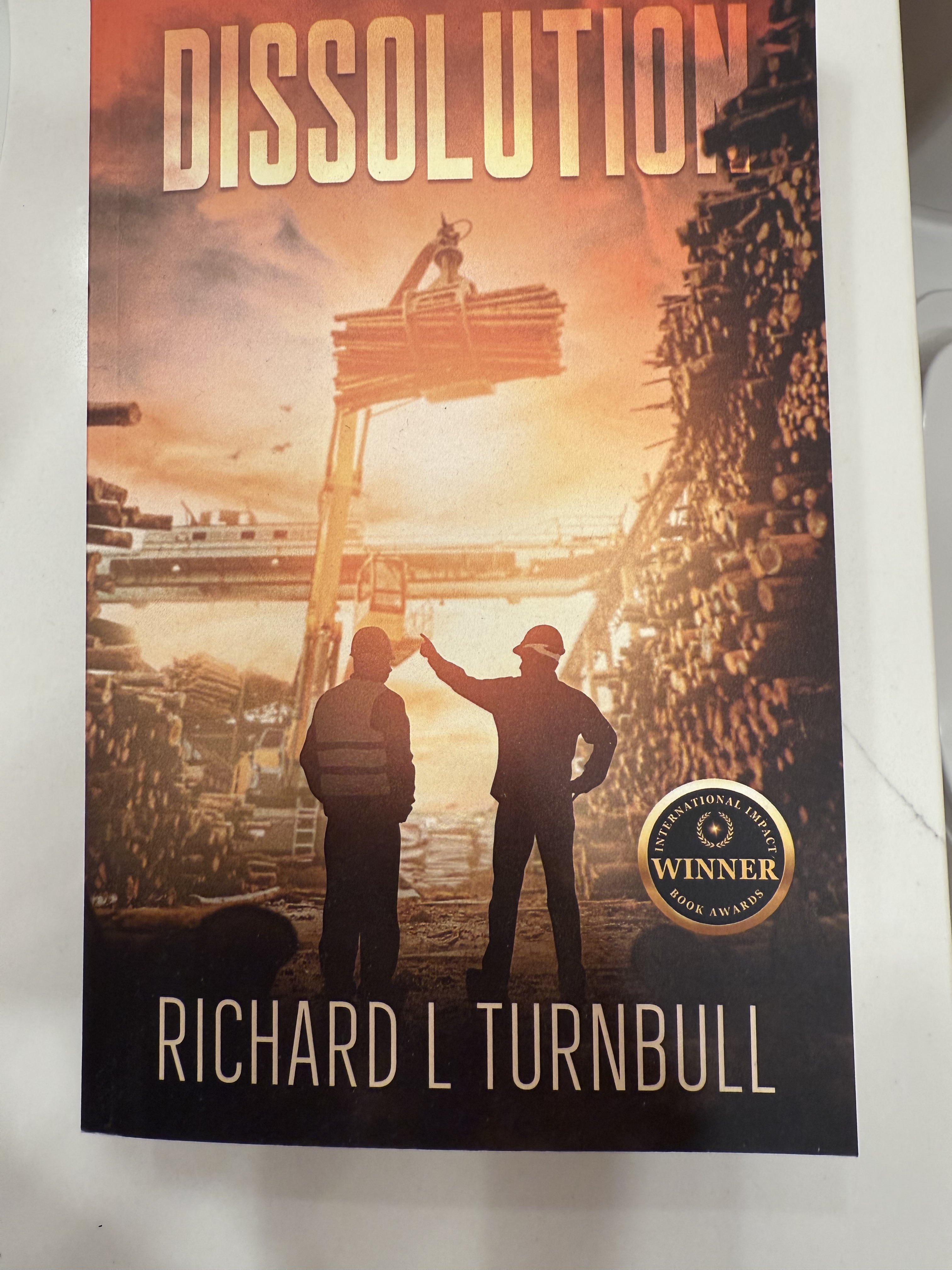
By Richard L Turnbull
When I began writing “Resolution”, I began with what is now Chapter 8. But let’s go back in time a bit and start over. The real story begins in 2014.
Chapter 1: Skaiyu Falls – 2014
Sheets of rain were blowing crosswise across the Skaiyu River bridge. The windshield wipers were on full speed, and even with the headlights on, I had trouble seeing the road through the darkening gloom. I was almost home. I imagined the smell of the smoke from our wood-burning stove and the aroma of the roast chicken dinner my wife, Nancy, was preparing. I was looking forward to getting out of this storm and into our warm and cozy cabin at the base of Bald Mountain. The rain ricocheted off the car’s roof like a machine gun, but what followed was beyond belief. The thunderous roar was deafening. It seemed like the whole mountain was collapsing. Terrified, I spun the car around in the middle of the bridge and sped away from the mountain of mud, rocks, trees, and debris that were hurtling toward me. My wife and three children were at home and in the avalanche’s path. The wall of mud and boulders dammed the river, forcing it out of its banks. The river, swollen from a week of steady, heavy rain, was already at flood stage, and now it poured over the landscape as it surged down the mountain, wiping out my escape route. I turned west onto a gravel road, hoping I could reach higher ground out of the river’s path and the mud. When I was safe, I slowed down and tried to call for help. No signal.
My family had just moved to the small community of Skaiyu Falls. I had a paper map in the car to help us become familiar with the lay of the land. I frantically searched the map, looking for a route to the nearby town of White Rock. I was on USFS Road 63, which eventually merged with USFS Road 47, which led to the main highway to White Rock. I estimated it would take about half an hour if the roads weren’t blocked with downed trees. When I reached White Rock, emergency personnel were already mobilizing. There were dozens of emergency vehicles, all with lights flashing through the dark, sparking shadows of men in reflective vests.
I stopped at the White Rock Police Station to tell them what I had witnessed. Given the size of the mudslide, it was possible that hundreds of people were buried alive under tons of mud and debris, and it would require an immediate response with heavy equipment to try to rescue those who may still be alive. The duty officer asked about the route I had taken. I assured him it was safe up to the Skaiyu River Bridge, but that the bridge was most likely demolished in the landslide, and the emergency crews would have to approach Skaiyu Falls from higher ground. The duty officer communicated that to the Incident Commander, who huddled with local and county officials to plan the immediate response.
I could only hope that, by some miracle, my house had been pushed off its foundation and floated along on the top of the mudflow rather than being buried under it. I needed to find a way back to Skaiyu Falls. The entire community of White Rock turned out to help in any way they could. I joined a crew with bulldozers and dump trucks, and we set off through the dark. We used logging roads to head up the mountain to the northwest corner of what used to be the community of Skaiyu Falls. The person in charge was afraid the mountain was still unstable and that we would be in the path if it gave way. Despite the risk, we unloaded the D-9 dozers with their huge buckets and followed them on foot as they slowly and cautiously moved to the edge of the main scarp. About twenty of us were on foot, equipped with headlamps and shovels. The only light was from the headlights of the trucks, rescue vehicles, and our headlamps. I desperately searched through the dark, punctuated by the flash of search lights from the circling helicopters, for any sign of my house. I wondered how the helicopters could stay aloft with the high winds and driving rain. Could my family have survived? I hollered desperately into the dark, “Nancy!
My voice vanished into the rain.
“Sara!”
“Robbie!”
“Sophie!”, my voice dying in the heavy dank air.
“Wait,” someone said sharply.
“Everyone – stop.”
Engines died. The rain took over.
“Yeah,” another voice said.
“That’s a kid.”
“Where are you little one? It’s ok. You’re going to be ok. You’re not alone. Shine your lights over here, I can’t see him. Look! There! Throw me a rope! I’m sinking.
“Tie it around your waist!”
“Easy-easy-don’t move, kid. I’ve got you.”
“Truck’s backing up!”
“Hold on-hold on.”
The truck backed up slowly, pulling the toddler and me out of the freezing muck.
We worked all night, but the only person we found was the toddler. There was no sign of my home. No reply from my incessant calls to my wife and children. Only darkness and rain.
It was raining so hard, the logging roads were turning to mud and rear-wheel drive trucks were slipping and sliding on the steep hillside. Logging companies, like Beekman Enterprises, knew how to build roads quickly, and they provided dump trucks loaded with gravel, dozers and other equipment to build new access roads and repair the surface of existing roads so that rescuers could reach the slide area.
White Rock turned the school gymnasium into a shelter, providing rescue workers with clean clothes, cots, blankets, and a place to shower and clean up. I was exhausted and filled with despair, and rage. My entire family was dead, buried under tons of mud. How could this have happened? Was it just a fluke of nature that the mountain gave way? Could it have been prevented? Should I have known that the land was unstable? Should I have asked more questions before signing the sales documents? Jesus! Was I to blame for the deaths of my wife and children? I showered, claimed a cot, and fell into a fitful sleep, dreaming I was caught in an avalanche and swept into a crevasse.
I awoke to the rustling of rescue workers getting dressed to resume search and recovery operations. After dressing in my donated clothes, I headed out of the school to get desperately needed coffee. I felt numb. My whole world had collapsed.
Fifteen people were rescued through airlift and on-the-ground efforts. But some of the rescuers who went in got caught up to their armpits and had to be dragged out by ropes themselves. It was just physically impossible to support human weight in the slurry that buried the community.
White Rock was teeming with news vehicles. A woman, worried about her uncle, raised her hand. Her voice shook. “Are crews still hearing people calling out?”
The County Commissioner paused. “No,” he said. “We are not hearing voices this morning.”
“The soil is unstable,” he continued. “We made the call early today. It’s not safe to put more people in that area.”
I walked across the highway to the White Rock Cafe.
“Coffee?” the waitress asked.
I nodded.
“I’m Mavie,” she said. “You helping with the search?”
I shook my head. The sob came before I could stop it.
“Oh,” she said softly. “Did you lose someone?”
She pulled a chair over and sat beside me. I began to cry; a deep uncontrollable sob that shook my whole body. I couldn’t answer. I buried my head in my arms on the table.
I couldn’t answer. The tears streamed down my face, and I convulsed with a tremor that rattled the salt and pepper shakers on the table. She sat with me, put her arms around me, and held me as I cried. Gently, Mavie released me, and softly said, “I am so sorry. This is not the end, you know. Not for you. Not for this town. We need to know what happened and why. Let’s get some food in you. How ‘bout some biscuits and gravy? We’ve got the best biscuits in the county. Hands down.”
I wiped away the tears with a thin, paper napkin and replied, “Thanks. You are very kind.” I took a sip of coffee and shivered. My brain was filled with questions. What must I do next? I needed to call my supervisor at the Seattle Times where I worked as a reporter. Where would I stay? Should I try to find a place in White Rock and report on the landslide? Could I be an objective observer?
Mavie appeared with a platter of biscuits and steaming gravy with a side of two eggs sunny-side up. I was hungry, and this country breakfast was just what I needed.
“Thank you, Mavie. This looks and smells delicious. I have a question for you. With my house buried under ten feet of mud, do you have any recommendations on where I could stay for a few days, maybe weeks?”
Mavie replied, “Well, we have a room over our garage you could use. I’ll have to check with my husband, but I’m sure he won’t mind. Mind you, it’s not much, but it’s dry, and we have a space heater you could use. Check back at lunch. Other than that, there is the motel down the street, but I heard it is full of rescue workers right now. You know, my daddy fought against that subdivision. He spoke out against it. The County Commissioners didn’t want to hear it. They claimed he was against growth and progress. Well, that may be partly true, but he works for the contractor that built those streets, and the gravelly soil on that steep hillside just wasn’t suitable for housing. At least, that’s what he said.”
Did corporate greed over just 25 acres of forest kill my family?
Chapter 2: What Caused The Slide? Searching For Answers
2014
For weeks, every thought of Nancy and my kids made me gasp and sob at the dark, hopeless finality of their deaths. The impossibility of their return to my life and the suffocating silence of my room above the garage left me devoid of hope. I could find no words to express my feelings. I couldn’t sleep. I couldn’t eat. The terror of their deaths overwhelmed me. My suffering was aggravated by my fear that my lack of research on purchasing this mountainside property led to their deaths. Did I fail to protect my family?
I couldn’t think. I couldn’t write. So, I walked. I walked through town. I hiked into the forest. I climbed to the top of the mountain and looked down over the debris field that buried my wife and my children. I sat at the top and shook with tremors of despair. And then I walked. I walked until I was exhausted and then crawled into my loft over the garage and slept, or tried to sleep with nightmares punctuating the dark. Every day for weeks, I walked. Alone. Refusing and unable to engage with anyone. I walked toward nothing. I just walked. There was no destination. How could there even be a destination worth walking to? I just walked. Every painful, heavy step a burden. And yet, I walked. Through the rain, through the cold, I couldn’t stop. I plodded forward until I could walk no more. And would then return to my space over Mavie’s garage.
I heard a knock and opened the door to find Mavie standing on the landing outside my loft. She held a tray of pancakes, bacon, a pot of steaming hot coffee, and juice.
“It is time”, she said. “You need to eat.”
She handed me the tray of food, turned, and left.
The warmth of the food and of the gesture relaxed me. I felt my body soften, and I sat at the little table and devoured the kindness she delivered.
Chapter 8: Hypoxia – 2039
“Jesus. Get off me. You’re standing on my nuts, you ungrateful furball! Stop licking. You have bad breath. Okay. Okay. I’ll get up, just get off of me. Christ, you are annoying in the morning. When did you sneak up here, anyway?”
It was early. It was still dark outside. Maybe if I just rolled over, he would lie back down and go to sleep. Wishful thinking. I knew that once the dog was up, he was up and needed to go outside to pee. Hell, I needed to pee. I got up, stumbled into the adjacent bathroom. When I returned to the bedroom, I pulled open the top right dresser drawer and grabbed a pair of clean undershorts and a clean t-shirt. I checked my cell phone for the latest weather. Thirty-nine degrees with light rain for the next hour said the report. What a miserable place to live I thought. Oregon. Land of eternal rain. And fog. The dismality of winter in Oregon. Dismality, I thought. I just coined a new word. Brilliant! I finished getting dressed, attached a leash to the dog, stuffed two poop bags into my pocket, and we stepped out into the cold, damp morning. Dismality. A brilliant start to another dark, damp, dismal day.
I feel old. My back hurts. My legs hurt. My feet had gone numb two years before. Hell, I am old. When did I get so damn old? My body’s giving out on me, but I have the self-image of a thirty-year-old. I’m shocked every time I look in the mirror. On the way back from our walk, I stop at the mailbox at the end of the driveway to pick up the paper. I have two plastic boxes for the paper delivery. One for the New York Times. One for the Gazette Times. Both boxes are empty. I haven’t had a paper delivery in years, but I still check, out of habit, I suppose. It’s a shame. I hate reading the news on-line. Actually, I hate reading the news. It is so grim. The collapse of America happened so fast. No one anticipated it. One day, we were the United States of America, and all of a sudden, we were a provincial republic. Like the Soviet Union before us, the nation collapsed without bloodshed. No one thought it possible. But our elected officials negotiated away my country. It was to be expected, I suppose. In hindsight, the polarization was too great. After Trump, half the nation slid into an alternate reality based on conspiracy theories and a worldview of victimhood.
Oregon was lucky, I guess. With other western states, we were a bastion of freedom and liberal thought. We were so enlightened we had no tolerance for other perspectives. We had the truth. And we were confident in that truth. We were awash with woke liberal snobs terrified of committing micro-aggressions against “they, them, theirs” and people with hidden identities. God forbid someone would be offended because I used the wrong fucking pronoun. I can’t figure it out, and honestly I don’t give a shit. They know I’m old. They can brush it off as words from a neanderthal and let it go. I’m two maybe three generations behind. It’s not that I don’t pay attention to the world morphing around me. It’s just that I don’t care anymore. Organizations, like my news agency, have manuals, essentially equity language dictionaries, that are puritanical guides written in a quest for salvation. Among the enlightened, there is a need to purify language that cleanses the ugliness of society by linguistic decree. The compulsion to use equity language doesn’t change the circumstances of existence, but is designed to spare the feelings of those who speak the tortured linguistic pretzel of American language.
The dog and I finish our walk. I take off his leash and harness, grab a towel from the hook in the hallway, and he dashes into the living room and rolls on the carpet, rubbing his wet, stinking fur into the rug. I disgustedly cover him with the towel and try to finish drying him off before he rubs anymore dirt and stink into the rug. What a pain-in-the-ass! He follows me into my home office and I remove a plastic bin of dog pellets from the closet and place a scoop of brown nuggets into his food dish. “You’re welcome, I say.” He ignores me, but his tail is wagging like a metronome stuck on allegro.
I have an article due tomorrow. The editor has been sending me hourly emails, which I ignore. I retired fifteen years ago, and I’ve never been particularly concerned about my financial well-being until recently, and now I find my IRA hasn’t kept up with my spending requirements. Or maybe the cost of everything has skyrocketed so much because we are regulated to death. I don’t want to leave my house, but the property taxes make it a challenge to continue to live alone in a single-family dwelling. An SFD. The Ameriwest Province has put a moratorium on building SFD’s. In order to preserve natural areas, families are now crammed into high-rise buildings. My SFD is grandfathered in, but once I move out or die, it will most likely be demolished and either merged with neighboring SFD’s and converted to a multi-story dwelling or turned into green-space. So, I must supplement my income until I am moved into a senior living center or die, whichever comes first. So, I write. And miraculously, they pay me. One column per week. Seems easy. But they expect some brilliant insight into society each week, and I have a brilliant insight about once a decade. The two don’t quite match up. So, I write out of terror that I will be forced out of my house. No other reason. But terror, I find, is a motivator. So, I write.
My desk is an adjustable plank of wood that I can raise or lower as needed. My office chair is an ergonomic sensation that I adjust every fifteen minutes or so. I have two laptop computers sitting side-by-side with a giant six-foot curved screen partially blocking a window that gives me a glimpse of the daily Oregon gloom. I use one computer for writing and the other for research and the giant screen allows me to have multiple documents open and visible at once.
I’m writing a column about the state of Oregon’s fishery. Oregon used to be famous for its abundant fish. King salmon, coho, steelhead, halibut, ling cod, rockfish, dungeness crab, shrimp, oysters, clams, and sea urchins are all gone; victims of a warming, acidic ocean. An entire fleet of rusting hulls of fishing boats parked forever on the docks of Newport with for sale signs. No buyers. No hope of recovery. Global warming efforts were too little and too late. Giant patches of hypoxia, where low levels of oxygen create death zones for fish border the Oregon shoreline. Some fish species have moved north into cooler waters, some have moved farther offshore, and some have just died off.
The fishing industry is now highly regulated. Fewer fish mean fewer boats. Fewer boats mean more expensive licenses. Expensive licenses mean higher prices. Higher prices mean less consumption. Less consumption means less pressure on fish stocks. But it doesn’t really matter. Ocean warming and acidification result in species extinction. I head to the docks and find an old man sitting on a crab pot mending a seine. He has about a five-day growth of salt and pepper gray beard, and longish brownish-gray hair sticking out from under his black stocking cap. His face is weathered leather, also brownish gray. He’s wearing a black turtleneck sweater under a worn brown raincoat with yellow rain pants and rubber boots.
“Are you headed out soon?”, I ask.
“Nah. There’s nothing open today. Just getting the gear ready in case there is an opening tomorrow. Little chance of that, though. But what the hell, I’ve got to do something. Might as well keep the gear in good shape and be ready for the next opening.”
“How long has it been since you’ve had your boat out?”
“Oh, about two months, I guess. I stopped keeping track. It’s too depressing. But if you own a boat there is always work to do. I just don’t get paid for it. I should have sold the boat years ago. Now it’s worthless. But I keep it painted. I try to keep the gear up in case there ever is a buyer, or if there is a miracle and the season opens again.”
“How do you manage to survive?”, I ask.
“I don’t need much. I live on the boat. I don’t have a mortgage and I can bartend when one of the restaurants needs someone to fill in.”
“How about your crew? What do they do when they aren’t fishing?”
He took a while to think about the question and then slowly answered. “Well, that’s the bitch of it. Finding a crew anymore is near impossible. Those boys can’t wait around until the goddam Department of Fisheries decide to open things up for a day or two. Most of the good ones have moved on. This here’s a dying town. Sure, there’s still tourism in the summer. But winters here are a cold wet bitch. No one can afford to live on three months’ income. So, look around. Half the fucking town is boarded up.”
I look across the street. All three businesses in view are closed. A restaurant. A bar. A fudge/taffy shop. All closed. A beat-up looking Dodge Ram pick-up with paint peeling off the sides revealing the gray undercoat beneath the once white paint, was parked directly opposite us with its rusted rear bumper askew. Down the street, the cannery is boarded up with a for-sale sign posted above the door. Like the logging towns before it, Newport and most other ports along the coast are either dying or dead; victims of global warming and failed public policy.
“Can I buy you a beer?”, I ask.
“Nah. I’m an alcoholic. I don’t stop once I start. I stopped drinking 25 years ago and have no intention of starting again. I’m better when I’m sober.”
“Okay. Good luck”, I say. I turned away and walked back to my car. For no particular reason, I turned back around and asked the fisherman his name.
“Jan NielsIen”, he replied.
“Well, good luck, Jan Nielsen. I hope things open up for you.”
I head across the bay to the office of Jason Miller, the director of Ameriwest Oceanic and Atmospheric Administration. I have a 1:00 pm appointment. I park in the lot out front, plug my car into the charging station and walk into the administration building. There is a receptionist who smiles at me and asks politely if she can help me.
“I’m Robert Taylor and I have a meeting with Mr. Miller”, I reply.
“Okay, please have a seat Mr. Taylor and I’ll let him know you are here. May I get you a cup of coffee?”
“No thanks. What kind of beer do you have?”
She laughs, and says, “Darn. We’re fresh out of beer. Fortunately, the brewery is still open, so in emergencies I can just dash down the street for a quick one.”
“Well, this is an emergency”, I say.
Again, she laughs, flips her hair, and says, “I’ll call Jason. Maybe you can meet over lunch at the brewery.”
Within a minute or so Jason Miller appears wearing a gray suit, white shirt, and a mauve colored tie. We’ve met several times over the years. He’s probably the most buttoned-up human I’ve ever met. He seems totally out-of-place working for an organization like AOAA. A turtle-neck sweater and jeans seem like it would be more appropriate. But what do I know? I dress like a bum.
“Hello, Robert. Good to see you. Come on in.”
“Hi, Jason. It’s been a while. Thank you for meeting with me. I’ve got a deadline to meet and appreciate your time.”
“What are you writing about?”
“Well, you know. The usual crap about how the government fucks up our lives with ridiculous rules, laws, and prohibitions. I figured you might know a lot about that.”
“Gee, Robert. I’m glad you consider me such a good source. If you’ll stand on that square of tile over by the coat rack, I think we might both have an amusing moment. The square is a spring-loaded trap door into the harbor. You’ll probably find many of your conspiracy journalist friends treading water down there.”
“Thanks for the tipoff. Let the lot of ‘em drown. I don’t need their competition. But, look, what the hell is happening out there in that big blue ocean?”
“It seems humanity may have made some judgment errors about resource utilization, waste management, fossil fuel consumption, and a few other things. I think that’s about it in a nutshell.”
“No shit, Jason. But I’m not stepping on your trapdoor. What’s going on? What’s causing the hypoxia? Is there anything we can do to fix that? Is there any hope for fishery recovery? What about fish farming? It seems we’ve done a lot to reduce carbon output in the last twenty years. Won’t that make a difference? Or are we all just screwed?”
“Again, in a nutshell, I would suggest you not have any more children. Their world will not be a pleasant one.”
“Damn! I’ve been hoping for more children to raise. Way to squash my dreams! Are you just going to be a smart-ass for this whole interview, or are you going to help me get some information out to the public who is waiting with baited-breath for my column?”
“If you are writing a feel-good story to help people feel better about their disintegrating world, then I may not have much information for you. Ocean mining for rare metals to build the batteries that fuel their electric cars is not exactly a great story for saving the oceans.”
 Dissolution